Test & Measurement
Megger vs Multimeter: Stop Asking Which Tool, Start Asking What You're Measuring
-
Megger vs multimeter: the question that misses the point
-
Why the comparison is built on a category error
-
Do not stop at the megger logo
-
Pressure transmitters cause the same confusion
-
CMM price is the same trap in a bigger budget
-
The real cost is the second failure
-
A quick way to think about the next urgent call
Megger vs multimeter: the question that misses the point
At about 9:47 p.m. in March 2024, I took a call from a maintenance lead at a packaging plant. A motor on the main line had tripped. On the shelf they had a Fluke multimeter and an older model that everyone in the plant simply called the Megger. The question was: megger vs multimeter, which one? My answer sounded frustrating: it depends on what you need to know.
That is not a dodge. The deeper problem in urgent instrument decisions is usually not equipment failure. It's that we compare products before we compare measurements. People search for 'fluke multimeter and megger' as if these tools are alternative versions of the same device. In most troubleshooting and maintenance work, they are not alternatives. They are two separate steps.
From 2022 through 2024, I coordinated roughly 200 rush instrument deliveries. Maybe 180 if I had to pull the logs, but the pattern is clear. The expensive mistakes rarely came from a late shipment. They came from someone using the right-looking tool for the wrong task, and then making a decision based on that result.
Why the comparison is built on a category error
A multimeter is a general-purpose electrical instrument. It reads voltage, current, resistance, continuity, and often capacitance and frequency. When its resistance range checks a cable, it sends a small internal voltage through the circuit and calculates resistance from that low-voltage measurement.
An insulation tester, historically called a megger, does something different. It applies a controlled DC test voltage, often 500 V, 1000 V, 2500 V, or 5000 V, and measures leakage current as insulation resistance in megohms. That high voltage is not there to impress anyone. It is the test. Many insulation defects only show up when the dielectric is stressed under the rated test voltage. A low-voltage ohmmeter simply cannot expose those defects.
So if you are asking 'megger vs multimeter' as if there is one winner, the practical answer is that a maintenance toolkit needs both. Standards in the IEC 61557 series exist because insulation resistance testing has to be done under defined conditions. A general-purpose multimeter is not designed for those conditions.
Do not stop at the megger logo
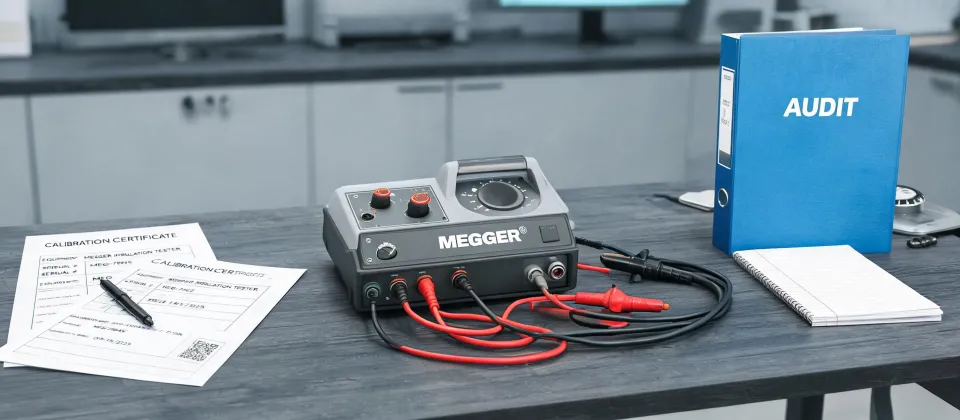
Here is where the megger logo causes trouble. Megger became a generic term for insulation resistance testers a long time ago, the way Kleenex became a generic word for tissues. The logo on the side tells you who built the instrument. It does not tell you whether that instrument is correct for the insulation test you are about to run.
There are 500 V megger-brand testers, 1000 V testers, 5000 V testers, and higher. If the test voltage is too low, weak insulation can look acceptable. If it is too high, you can stress something unnecessarily and create a new problem. The megger logo is a quality signal, not a substitute for verifying the tester's output voltage and the equipment's insulation test specification.
Add that to your pre-test checklist: know the failure mode, know the test voltage, and only then connect the instrument. That 30-second check has saved me far more time than it ever cost.
Pressure transmitters cause the same confusion
This category confusion is not limited to electrical test equipment. In an industrial process upset, the first reaction is often to order replacement single pressure sensors & transmitters because the display shows a bad signal. I have seen rush orders for pressure transmitters that should never have been placed.
If you put a multimeter in milliamps mode on the 4-20 mA loop, you can often see whether the transmitter is reacting to pressure changes. If the current is stable and reasonable, the sensor may be fine, and the real problem could be a damaged cable, a loose termination, or an analog input card. Five minutes of loop checking beats replacing several single pressure sensors & transmitters and still seeing the same fault on the screen.
CMM price is the same trap in a bigger budget
This pattern also shows up in capital equipment purchases. When I receive a request to compare CMM price before the measurement requirement is defined, I know we are about to repeat the megger vs multimeter mistake on a much larger scale.
A coordinate measuring machine price only means something after you specify the parts you will measure, the tolerances you need to verify, the probing system you plan to use, and the environment where the machine will operate. CMM performance is assessed against standards like ISO 10360, but those numbers are only meaningful when the test is defined. Comparing CMM price without defining the measurement task is like comparing megger logos without checking the test voltage.
The real cost is the second failure
In one food plant outage, a technician used the continuity range on a multimeter to verify a motor feeder cable. The cable was continuous, so the team cleared it for restart. The drive tripped again about 25 minutes later. An insulation resistance test on the same cable found leakage to ground that only appeared when the insulation was stressed at the proper test voltage.
The first check gave false confidence. The second failure meant another shutdown, another investigation, and another restart under pressure. The total overtime and lost production cost was more than three thousand dollars. The insulation tester had been sitting in their electrical room the whole time.
Prevention is cheaper than cure. I do not mean buying every possible instrument. I mean spending 30 seconds to match the instrument to the failure mode before applying it. A checklist is the cheapest insurance you can keep in a plant.
A quick way to think about the next urgent call
When the clock is running, do not start with the brand or the model number. Start with the measurement that will give you a trustworthy answer.
- Need voltage, current, continuity, or a loop signal? Use a multimeter.
- Need to prove insulation health under stress? Use an insulation tester, not the ohms range on a multimeter.
- Need to confirm the right megger is on hand? Check the test voltage. Do not stop at the megger logo.
- Need to troubleshoot a pressure problem? Measure the 4-20 mA loop before ordering replacement single pressure sensors & transmitters.
- Need to buy a coordinate measuring machine? Define the tolerance and part envelope before asking for CMM price.
Take it from someone who has arranged too many overnight couriers: five minutes of verification beats five days of correction. The Fluke multimeter and the Megger are not competing. Use each one for what it was built to do, and you will prevent more emergency calls than any rush delivery service can fix.

Marcus Feld
Marcus Feld is an electrical test and measurement analyst specializing in multimeters, oscilloscopes, clamp meters, insulation testers, spectrum analyzers, and data loggers. He applies IEC 61010-2-030 and IEC 61010-031 concepts while examining measurement category, bandwidth, true-RMS response, input loading, and stated uncertainty. His work helps maintenance engineers and test teams choose safe instruments with performance suited to the signals and environments they actually measure.