Test & Measurement
The Best Test Instrument Is the One That Matches Your Failure Mode
-
My rule: buy for the failure you actually have
-
Argument 1: The Megger MIT410/2 is excellent—until you need 5 kV
-
Argument 2: A handheld spectrum analyzer won't fix a 60 Hz gremlin
-
Argument 3: Troubleshooting a Rice Lake load cell is a sequence, not a part swap
-
But isn't this just telling people not to buy?
-
My pre-purchase checklist
My rule: buy for the failure you actually have
The best instrument isn't the one with the longest spec sheet. It's the one that matches the failure you're actually chasing. I've been handling test instrument orders for a systems integrator for 11 years. I've made—and documented—six expensive mistakes, totaling about $18,400 in wasted budget. Now I keep the pre-purchase checklist for our team.
Most of those mistakes weren't bad brands. They were honest misunderstandings about what a tool was for. That's why I'm suspicious of any recommendation that says, 'This is the best.' There's no best. There's only the right voltage class, the right measurement domain, and the right troubleshooting sequence.
Argument 1: The Megger MIT410/2 is excellent—until you need 5 kV
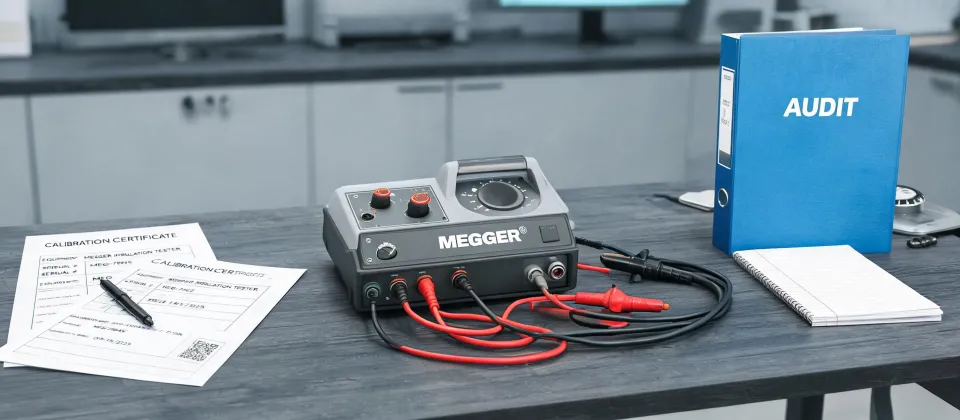
In my first year (2014), I ordered a Megger MIT410/2 insulation tester for a plant maintenance crew. The request said 'insulation testing.' I saw Megger, I saw a rugged portable unit, and I approved it. Looking back, I should have asked one question: what voltage class are the cables?
The MIT410/2 is a great low-voltage insulation tester. Megger's published datasheet puts its test voltages in the 50 V to 1000 V range. That covers motors, switchgear, control wiring, and a lot of routine maintenance. It doesn't cover 5 kV cable testing. If your job is commissioning medium-voltage cables, the MIT410/2 is the wrong tool—no matter how good the brand is.
The Megger 5kV insulation tester price question is also misleading. People search for a single number, but a 5 kV tester is a different class of instrument. Price depends on maximum test voltage, insulation resistance range, PI/DAR testing, memory, safety rating, and calibration. I don't quote a price here because distributor quotes move and specs change. Check current listings and confirm the voltage class first. That one check would have saved us a $3,200 order and a very awkward return.
Argument 2: A handheld spectrum analyzer won't fix a 60 Hz gremlin
I once watched a team buy a handheld spectrum analyzer to chase an intermittent motor trip. It looked like the professional choice. It was also completely wrong for the failure. The problem was a loose neutral at a junction box. A $180 clamp meter and 20 minutes of looking would have found it.
Handheld spectrum analyzers are brilliant for RF work: interference hunting, transmitter checks, Wi-Fi and cellular site surveys, EMC pre-compliance. If your signal lives in kilohertz to gigahertz, they earn their price. If your signal is 50/60 Hz power, they mostly show you an expensive lesson in impedance mismatch.
The same domain mistake happens with mechanical tools. I've seen people order an 8-inch digital caliper for checking rough castings. Digital calipers are precise, but they hate grit, burrs, and hot surfaces. For general shop QC on machined parts, a digital caliper 8 inch model is a sweet spot: enough reach for most work, still handheld. For rough foundry checks, you want a different tool. I recommend the caliper for clean, controlled measurement—not for everything that has a dimension.
Argument 3: Troubleshooting a Rice Lake load cell is a sequence, not a part swap
The most expensive mistake I've documented was on a scale system. A production line had drifting weights, and the first instinct was to replace the Rice Lake load cell. In our case, quotes ranged from $600 to $1,500 depending on capacity and rating. We replaced it. The drift stayed.
The actual issue was moisture in the junction box. If you want to know how to troubleshoot a Rice Lake load cell, start before the cell. Check the mechanical installation: binding, debris, side loading, and foot alignment. Then check the cable and junction box for moisture or corrosion. Then measure excitation voltage at the cell. Then measure the millivolt output per volt (mV/V) and compare against the datasheet. Isolate one load cell at a time if the system has multiple cells. Only after that should you condemn the cell.
Rice Lake publishes troubleshooting guides that follow this logic. If I remember correctly, our cell was fine. The junction box had a cracked gasket. That repair cost about $90 and a half day of downtime. The replacement cell cost us $1,100 plus calibration, and we didn't need it. If the cell is physically damaged, corroded, or fails the mV/V check, replacement is the honest answer. But if you skip the sequence, you're just guessing with a purchase order.
But isn't this just telling people not to buy?
No. It's telling people to buy the right thing. There's a difference between being negative and being specific. I recommend the Megger MIT410/2 for low-voltage insulation testing. I recommend a 5 kV insulation tester for medium-voltage cable work. I recommend a handheld spectrum analyzer for RF diagnostics. I recommend an 8-inch digital caliper for clean machined parts. I recommend the Rice Lake load cell troubleshooting sequence before you order a replacement.
What I don't recommend is the fantasy that one instrument covers every job. That's the legacy myth from an era when catalogs were thin and buyers had fewer choices. Today, the problem isn't lack of options. It's matching the option to the failure. The vendor is 'flexible.' What I mean is they'll swap the unit if you push, but they won't fix your spec mistake.
Someone might say, 'This is just hedging.' It isn't. Hedging is saying, 'It depends,' and stopping there. Specificity is saying, 'It depends on these three things, and here's how to check them.' That's what prevents returns.
My pre-purchase checklist
Before I approve any instrument order, I run this list:
- What is the failure mode? Electrical, RF, mechanical, or process?
- What is the voltage, frequency, or dimension range?
- What environment will it see? Heat, moisture, vibration, dust?
- What standard or calibration applies? IEC 61010, NIST Handbook 44, or an internal spec?
- What's the total cost, including calibration, accessories, and training?
That last point matters. The lowest quoted price often isn't the lowest total cost. A cheap 5 kV tester with no calibration support can cost more than a better-supported unit. The same goes for calipers, spectrum analyzers, and load cells.
So here's my final position: the best instrument is the one that matches your failure mode, not the one with the best marketing. If a tool doesn't fit your job, don't buy it. Say so, document why, and move on. That honesty has saved my team more money than any discount.

Marcus Feld
Marcus Feld is an electrical test and measurement analyst specializing in multimeters, oscilloscopes, clamp meters, insulation testers, spectrum analyzers, and data loggers. He applies IEC 61010-2-030 and IEC 61010-031 concepts while examining measurement category, bandwidth, true-RMS response, input loading, and stated uncertainty. His work helps maintenance engineers and test teams choose safe instruments with performance suited to the signals and environments they actually measure.