Test & Measurement
When 'Just a Megger' Is Never Just a Megger: An Admin Buyer's Notes on Test Equipment Orders
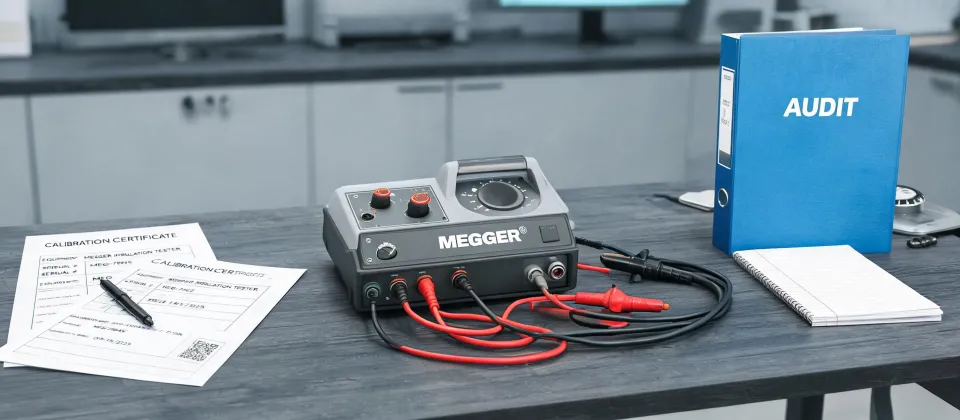
It started with a short work order
I run purchasing support for a 240-person manufacturing site. I do not sign off on capital projects, but I manage routine equipment orders: about 60 to 80 a year, from measuring instruments to safety gear. Most orders are simple. Some are not. The requests that are not simple usually look simple on the surface.
The request that taught me the most was a work order that said, need megger. That was the entire message. No model. No voltage. No application. No photo of the old unit. I searched for megger and ordered a mid-range insulation tester that happened to be in stock. It worked out because the technician needed a basic unit for routine motor checks. But I didn't know that at the time. I got lucky.
When I first started in this position, I assumed a megger was a specific instrument with one purpose. Then I got a request for a megger 15kv insulation tester. I almost replied to our supplier with a hand crank megger insulation tester because I thought it was the upgraded version of the same classic tool.
It is not.
The problem under the word
Megger is a brand name and also a generic expression for an insulation resistance tester. In the field, people use it as if it were a noun that names any similar tool. That works when you already have context. On a purchase order, the context is missing. Insulation testers are defined by test voltage. So the word megger is a starting point, not a specification.
An insulation tester applies a controlled direct voltage to an insulating material and measures leakage current. If the resistance is high enough, the insulation can probably handle normal service. If it is not, current leaks and the equipment may need repair. The value of the test depends on the voltage being appropriate for the equipment. Use too low a voltage and weaknesses can hide. Use too high a voltage and the test itself may stress insulation beyond what it was designed to take.
Two very different orders
A hand crank megger insulation tester is the classic unit. You turn the crank by hand and it generates a test voltage, usually at the lower end of the insulation testing range. For a 500 V or 1000 V class, it is useful for common plant equipment: motor windings, general wiring, and cables that operate at 600 V or below. It is portable, simple, and does not depend on a charged battery. That is still a good fit for a lot of routine electrical maintenance work.
The hand crank design has been around for a long time, but it is not just a nostalgic purchase. It is often bought because it is enough for the job and because technicians trust it. A decent basic unit might cost a few hundred dollars, based on the quotes I have collected from distributors in 2025. I avoid giving one fixed number because prices move and configurations differ. The point is that a hand crank megger insulation tester is a simple, accessible piece of test equipment.
A megger 15kv insulation tester is a different investment. This class of instrument is intended for medium-voltage cable, transformer bushings, switchgear, and similar equipment. You cannot test a 15 kV cable with a 1 kV hand crank unit and expect a meaningful answer. The instrument must generate a high enough voltage to stress the insulation under realistic operating conditions. The test setup is more complicated, and the people using it should understand high-voltage safety and basic insulation test methods.
Neither unit is automatically wrong. The wrong move is to buy a classification instead of matching the tool to the job. A team that only works on 480 V circuits does not need a 15 kV instrument just because someone heard bigger numbers are safer. With insulation testing, the voltage has to be appropriate for the asset. If it is not, the reading can be misleading or the test itself can cause damage.
The same pattern appears outside electrical work
The same issue showed up when a lab supervisor sent me a message that said, please check hplc system price. That was the whole request. An HPLC system can be a basic pump with a detector, or it can be a more complete system with an autosampler, column heater, diode array detector, software, and validation documents. Each configuration has a different price range. Without knowing what the lab planned to separate and how they planned to detect it, any number I sent back would have been mostly fiction.
Another engineer asked me for an oscilloscope probe. One probe. I appreciate that request because it shows the gap in the language we use. An oscilloscope probe is not a universal accessory. There are passive probes, active probes, high-voltage probes, and differential probes. There are 1x and 10x attenuation settings. There are bandwidth ratings and input capacitance limits. If you choose a probe with the wrong voltage rating, it can be unsafe. If you choose one that does not match the scope input, the waveform can be inaccurate. It is a small component with a long list of hidden requirements.
Even a question about reading a water meter follows the same pattern. A facility person once asked me how to read a sensus digital water meter. The exact message was, how to read a sensus digital water meter. I searched and found manuals for several different meter families. The displays were not the same. Some showed gallons in one sequence, some showed cubic feet, and some had diagnostic codes. Without the model number, any answer I gave was a guess. That experience made me ask for a label or part number before I searched for anything.
The deeper issue: we describe objects, not jobs
You could read all of those examples and think the requesters were being careless. I stopped thinking that after a few years. The deeper issue is that people describe tools using the label they use when they talk to coworkers. When an electrician says megger, they mean I need to perform an insulation resistance test. When a lab manager says HPLC, they mean a separation method they already picture in their head. When an engineer says oscilloscope probe, they mean a specific measurement setup they have used many times.
But I do not get to see inside their heads. I only see the request. As the buyer, my job is to translate that request into a complete specification before I call a supplier or click purchase. The translation has to happen before the search. The danger is not asking questions when I do not know the answer.
The real cost of guessing
I learned the cost of guessing from a small purchase. I ordered a cheaper oscilloscope probe instead of the exact replacement our engineer recommended. I saved about $45 on paper. When the engineer looked at the specifications, they saw a lower maximum input voltage rating than the rest of the lab bench setup. The probe could not be used where they needed it. The engineer sent it back, and I paid return shipping. We lost time, bought the original one anyway, and the apparent savings disappeared.
A wrong megger order has a larger version of that same math. If the job requires a megger 15kv insulation tester and I send a low-voltage hand crank unit, the asset may not be tested properly. The risk is not only a wasted line item. It is equipment that was supposed to be verified but was not. Or the opposite happens: someone spends far too much on a high-voltage test set for low-voltage motor checks. The equipment sits on a shelf because nobody wants to risk using it on a motor. Both extremes are expensive.
What I do now before placing the order
I ask three questions before I buy anything that does not have a clear part number. They sound obvious, but they work.
- What will it be used on? If the answer is motor, I ask voltage class and size. If it is cable, I ask whether it is a routine check or a commissioning test.
- What test voltage or measurement range is required? For insulation resistance, that means volts. For an oscilloscope probe, that means bandwidth and maximum input voltage. For an HPLC quote, that means the required detector and throughput.
- How will the result be recorded? If the team needs formal reports and trend comparison, a logging insulation tester may be worth the extra money. If they just need a quick pass or fail, a hand crank megger insulation tester can be enough. There is no universal best fit.
I also ask suppliers the same questions. Honestly, I let suppliers ask me questions. I get suspicious when a salesperson answers a vague request instantly. A good supplier will say, before I quote, tell me whether you are testing a 15 kV cable or a 480 V motor. The recommendation will be different. That kind of response is worth more than the fastest price.
The honest answer is that I do not know which megger you should buy. Neither does anyone else without knowing the job. If you are doing general low-voltage plant electrical checks, a hand crank megger insulation tester might be exactly what you need. If you are responsible for medium-voltage cable maintenance, you may need a megger 15kv insulation tester. If you are asking for an hplc system price, start with the configuration. If you are ordering an oscilloscope probe, find out what you will measure. And if your question is how to read a sensus digital water meter, get the model number from the meter face first.
These are not separate skills. They all come from the same habit: define the job before you define the part number. That habit has saved me more money and embarrassment than any supplier discount ever could.

Marcus Feld
Marcus Feld is an electrical test and measurement analyst specializing in multimeters, oscilloscopes, clamp meters, insulation testers, spectrum analyzers, and data loggers. He applies IEC 61010-2-030 and IEC 61010-031 concepts while examining measurement category, bandwidth, true-RMS response, input loading, and stated uncertainty. His work helps maintenance engineers and test teams choose safe instruments with performance suited to the signals and environments they actually measure.