Test & Measurement
What Is a Megger Insulation Tester? A Buyer's Plain-English Answer
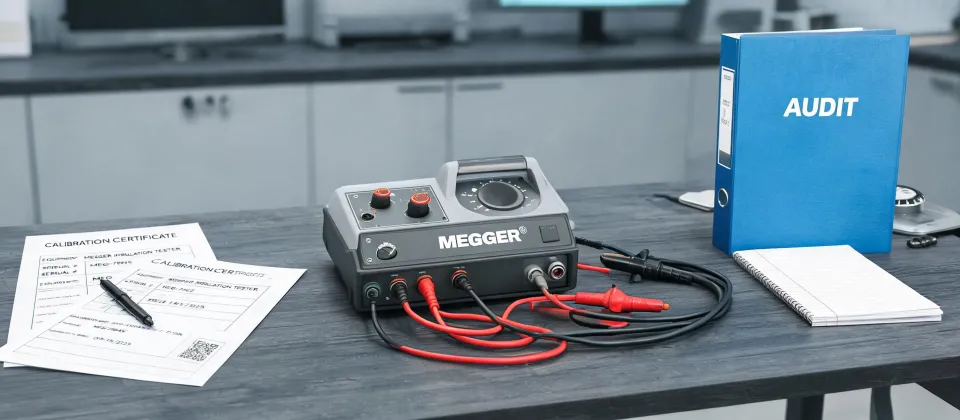
A megger insulation tester is a meter that measures the resistance of electrical insulation — it tells you whether current is staying inside the cable, motor winding, or transformer where it belongs. "Megger" started as a brand name (the British company, founded in the late 1880s) and turned into a verb, the same way Kleenex means tissue. When an electrician says "megger that cable," they mean the test, not necessarily the brand.
That's the definition. The practical question — the one that actually costs money — is what to buy. And on that front, the mistake I see most often is treating test voltage as a quality tier instead of a design choice. A 5 kV unit is not a "better version" of a 500 V unit. It's a different tool for a different job.
What I do, and why this is my problem
I'm the office administrator for a 130-person company. Since 2020 I've managed capital and consumable purchasing — roughly $80,000 a year across a dozen vendors. Office supplies, lab consumables, shop-floor tooling. I'm not an electrician or a lab tech. I'm the person who has to translate what the technical staff say they need into a purchase order, then survive the audit if I got it wrong.
I've bought four insulation testers in five years. My first was a misquote. So believe me when I say the vocabulary gap between purchasing and engineering is where most of the expensive mistakes live.
What the test is actually telling you
Insulation works because electricity takes the path of least resistance. Good insulation has very high resistance — hundreds of megohms, sometimes gigohms. As insulation ages, absorbs moisture, or picks up contamination, that resistance falls. The megger applies a DC test voltage higher than the normal operating voltage and measures how much current leaks through. Catch the drop early, schedule the repair, avoid the outage.
Here's the part that trips people up: test voltage needs to match the insulation system's rated voltage, not the other way around. A megger insulation tester 500V is the standard choice for low-voltage motor windings, control panels, and building wiring. A megger mit515 5kv insulation tester covers medium-voltage cables, large motors, and generators. Put 5 kV into equipment rated for 500 V and you don't get a better reading — you get damage.
The conversation that taught me this
Real exchange, spring 2022. Our maintenance lead said he needed "a Megger for the 480 V stuff, standard test voltage." I passed that to a distributor. The distributor quoted a MIT515 — the 5 kV unit — because for industrial work "standard" in their catalog meant the 1–5 kV range. Our electrician meant 500 V.
I ordered the MIT515. It arrived. Our electrician looked at the box, looked at me, and asked why I'd bought a $4,600 instrument for a job that needed something in the $900 range.
Here's the thing: we were both correct about our own vocabulary and wrong about the other person's. The conversation that fixed it took ten minutes. The return and re-order took three weeks. I now ask three questions before any insulation tester quote goes out — which equipment, what's the nameplate voltage, and is this diagnostic trending or pass/fail? Those three answers tell you everything.
On the MIT515 specifically
The Megger MIT515 is a 5 kV insulation tester with selectable test voltages, polarization index and dielectric absorption ratio capability, and internal storage for trending. It's the unit I'd quote for utility work, large industrial motors, and medium-voltage distribution cable. If you're testing 480 V motors, it's overkill. If you're testing 4.16 kV switchgear, anything less is useless.
Pricing from distributor quotes I collected in early 2025 lands in the mid four-figure USD range, but ask for a current quote with the calibration certificate included — some listings quietly skip that line item. Verify before you sign.
Best multimeter for automotive — the short version
One of our fleet guys asks me this roughly every eighteen months when a previous unit walks off or gets dropped. The criteria don't change much:
- True RMS. Non-negotiable. Modern ignition and injector waveforms aren't clean sine waves, and a cheap averaging meter will lie to you.
- CAT III 600 V rating minimum. This is a safety category, not a spec-sheet flourish.
- Fast audible continuity, ideally with a low-impedance mode for ghost-voltage hunting.
- Temperature capability, if diesel diagnostics are in scope.
Our shop runs a Fluke 88V. Before anyone asks — I'm not saying it's the only good answer. Plenty of techs run Klein or Extech and get identical readings. The price gap is mostly durability and calibration support. If your techs drop tools off ladders, that premium pays for itself. If not, save the money.
Wait — why is a MiniSpin centrifuge on this list?
Because in small-company purchasing, everything lands in the same inbox. MiniSpin is Eppendorf's entry-level benchtop microcentrifuge for spinning down 1.5 mL and 2.0 mL tubes in molecular biology labs. It has nothing to do with electrical testing. It ends up in the same article because I buy it, and because the same dynamic plays out: a distributor assumes "you probably want the bigger model" and quotes accordingly.
Here's the thing I keep coming back to — the vendors who took my single-unit inquiry seriously back in 2020 are the ones I call now for five-figure orders. Small doesn't mean unimportant. It means untested.
Where I'd push back on everything above
If your company doesn't have test standards written down, stop and do that first. Every recommendation here assumes you know what you're testing and why. Write the standard — test voltage, resistance threshold, pass/fail criteria, calibration interval — then buy equipment to match it. Buying the equipment first and figuring out standards second is how you end up with an MIT515 on a shelf and a rented 500 V tester on the shop floor.
Also — if you test fewer than five times a year, rent. A 5 kV insulation tester is a five-figure-cycle capital purchase with a calibration obligation attached. A week's rental runs a fraction of that. The exception is critical-equipment work where turnaround time matters more than cost.
And one more thing I learned the hard way in 2022: check the calibration certificate serial number at delivery, before you sign for it. Ours matched a different unit and took four emails and two weeks to sort out. Verifying on arrival takes thirty seconds.

Marcus Feld
Marcus Feld is an electrical test and measurement analyst specializing in multimeters, oscilloscopes, clamp meters, insulation testers, spectrum analyzers, and data loggers. He applies IEC 61010-2-030 and IEC 61010-031 concepts while examining measurement category, bandwidth, true-RMS response, input loading, and stated uncertainty. His work helps maintenance engineers and test teams choose safe instruments with performance suited to the signals and environments they actually measure.