Test & Measurement
The Fastest-Shipping Test Instrument Is Often the Wrong One
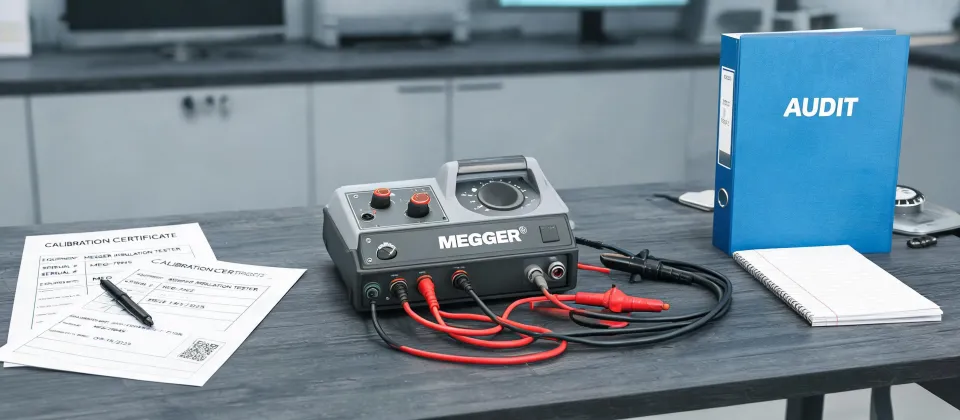
If you're buying a test instrument on a deadline, the vendor who can ship today is usually not the vendor you should buy from.
That's not a knock on fast suppliers. It's a warning about what "in stock, ships today" actually tells you — and what it quietly leaves out.
In my role coordinating rush orders for an instrument calibration and distribution company, I've handled more than 400 expedited orders over the past nine years, from a $700 clamp meter to a $15,000 power quality analyzer package. Most start the same way: "We need it by Friday," followed by a spec sheet screenshot and a request to match it.
Here's the thing: by the time a customer calls me, they've usually already called two or three vendors and picked the fastest quote. That quote is the problem.
Argument 1: "In Stock" Says Nothing About Calibration
Most buyers focus on lead time and unit price and completely miss calibration traceability.
An instrument without a current, traceable calibration certificate is a very expensive way to generate numbers nobody can defend in an audit. This matters more in regulated work — pharma, utilities, aerospace suppliers — but it sneaks up on everyone eventually. A maintenance tech signs off on a panel check with a meter that was last calibrated 14 months ago, and six months later the report gets challenged.
Here's the counterintuitive part. The vendors who ship fastest are often the ones with the least calibration capability. They're fast because they skip the step, not because they're efficient. A calibration lab adds three to seven days to an order. A reseller with a warehouse and a shipping account adds zero.
People think the fastest shipper is the most responsive. Usually it's just the one with the fewest steps between the shelf and the box.
So when a supplier says "in stock," the real question is: in stock, calibrated when, and can I see the certificate before it ships? If the answer is vague, the speed is coming from somewhere.
Argument 2: The Category Is Wrong More Often Than the Spec
Last spring a client called on a Wednesday needing a multimeter by Friday for a panel commissioning. We shipped a Hioki DT4222 — compact, CAT IV rated, genuinely the right tool for basic measurements on a 480V panel.
Except that's not what they were doing. Once they got on site, the job turned out to involve harmonic logging on a VFD. The DT4222 is a good meter. It just isn't a power quality analyzer. We ate the return shipping and the rush fee on the replacement, and the commissioning slipped by a day.
I assumed "multimeter" meant the same thing to both of us. It didn't.
The second version of that mistake is even more common. A customer sends a photo and says "same as this one." The photo shows an 88V-class automotive multimeter — a solid tool for diagnosing 12V systems, and simply the wrong instrument for three-phase power quality work. Nothing is broken. The category is just different, and the spec sheet doesn't say so.
This is why I've stopped treating "what spec do you need" as the first question. The first question is "what are you measuring, and what does the report need to say." The spec follows from that.
Argument 3: The Tool Is Half the Purchase. The Maintenance Chain Is the Other Half.
This is the part that surprises people outside the trade.
A 0–6 inch micrometer set runs somewhere in the $150–$400 range depending on brand and resolution, based on distributor pricing we compared in late 2024. The annual calibration on that set runs $60–$120. Skip the calibration and you own a very precise object that no auditor will accept. The set didn't get worse. The paper trail did.
Same logic applies to a clamp meter, an insulation tester, or a Hioki LCR meter bought for incoming component inspection. If you're rush-ordering the LCR meter, you should be budgeting the calibration interval at the same time you budget the shipping upgrade. Otherwise you've paid a premium to get an unverifiable instrument a day early.
And this isn't only an electrical-instrument problem. We get asked "how to clean an Eppendorf pipette" maybe twice a month. Nine times out of ten, cleaning isn't the issue. The pipette hasn't been calibrated since it left the factory, the drift is showing up as inconsistent volumes, and the user assumes contamination. Cleaning won't fix drift. Calibration will. The cleaning question is the symptom, not the problem.
That's the angle most rush buyers miss: the emergency is rarely the thing they called about.
The Obvious Objection
Fair pushback: in a real emergency, you don't always have time to audit a supplier's calibration lab or interrogate the category fit. Sometimes Friday means Friday and you take what's on the shelf.
Real talk: sometimes it does. But "no time to audit" is not the same as "no time to ask." Three questions take about six minutes:
- What's the calibration date on the exact unit you'd ship, and can you send the certificate before it goes out?
- Is this the right category for what I'm measuring, or the closest thing you have in stock?
- If it turns out to be wrong, what's the return and restocking policy on a rush order?
If a supplier can't answer the first one, the lead time is fiction anyway. If they won't answer the third, they already know returns on rush orders are painful.
Where I Land
A fast shipment of the wrong instrument costs more than a slow shipment of the right one. I've watched a $900 rush fee save a $40,000 commissioning window, and I've watched a $200 shipping upgrade turn into a $3,000 return because nobody asked what "multimeter" meant.
The honest answer — even when it's "this one probably isn't right for you" — is the one that keeps the project on schedule. The supplier who tells you that is usually the one worth calling back next time, deadline or not.

Marcus Feld
Marcus Feld is an electrical test and measurement analyst specializing in multimeters, oscilloscopes, clamp meters, insulation testers, spectrum analyzers, and data loggers. He applies IEC 61010-2-030 and IEC 61010-031 concepts while examining measurement category, bandwidth, true-RMS response, input loading, and stated uncertainty. His work helps maintenance engineers and test teams choose safe instruments with performance suited to the signals and environments they actually measure.