Test & Measurement
An Admin Buyer's Guide to Megger, Insulation Testers, Oscilloscopes, and Thermal Cameras
Why There Is No Standard Test Equipment Answer
When I took over purchasing in 2020, I expected to make a lot of decisions based on price. What I learned is that the biggest buying risk isn't overpaying. It's ordering the wrong tool. The tool works, but it doesn't fit the job, the project stalls, and finance sees a line item that needs a return authorization.
I'm an office administrator for a 200-person manufacturing company. I process 60-80 orders a year and manage roughly $150,000 in annual spend across 8 vendors. I'm not an engineer. But after five years of buying test and measurement equipment, I've stopped trying to pretend otherwise. I use a simple decision framework instead.
Here's the truth: there is no single right megger, no universal oscilloscope, no one thermal camera that works for everyone. What works depends on the scenario.
Scenario 1: 'Megger' Doesn't Tell You Enough
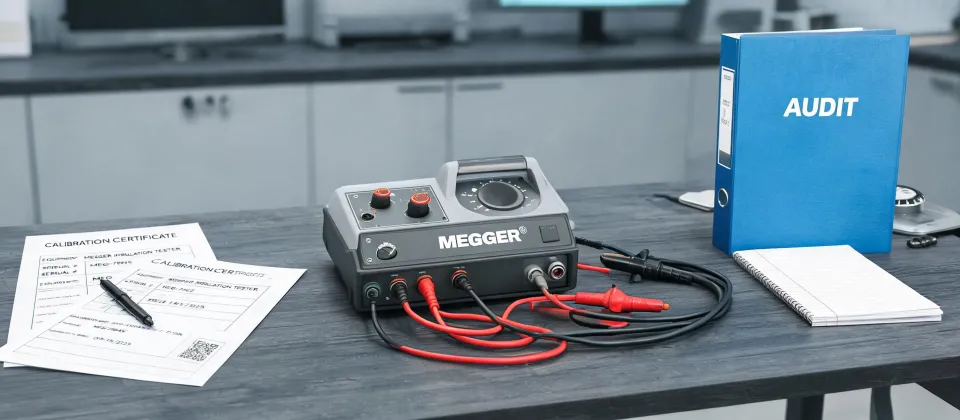
The word 'megger' gets thrown around in almost every electrical request. What most people don't realize is that Megger is a brand name. In a purchase order, it usually means an insulation resistance tester. But that's still vague.
When a request shows up as 'insulation resistance tester megger frequency,' I don't assume the tester itself has a frequency setting. A standard insulation resistance tester applies a direct voltage, often 250V, 500V, or 1000V, and measures resistance in megohms. The specification that matters is the test voltage, not frequency. If someone is asking about frequency, they usually mean the motor or cable under test, not a knob on the instrument. Ask that before you approve the PO.
If you're testing a de-energized circuit
You need an insulation resistance tester. That's the tool that tells you whether old cable insulation is breaking down before you put it back in service. The key spec to confirm is the DC test voltage, not 'megger frequency.'
If you're working on a live circuit
You need a clamp meter. If a request says 'megger clamp meter,' ask one question: is the primary job to measure current on a live circuit, or to check insulation resistance on a de-energized one? A clamp meter can measure current without disconnecting anything, but an insulation resistance test requires the circuit to be off. If both functions appear in one sentence, let the engineer tell you which one is the primary use. Oh, and check the included accessories. Two quotes for the same request can differ by $180 because one includes test leads and the other doesn't.
Scenario 2: Hardware Gap or Skill Gap?
Lab equipment requests used to be the hardest for me. The biggest mistake I made in 2021 was upgrading a 2-channel oscilloscope to a 4-channel because I thought more capability was automatically better. It wasn't. The engineer needed to compare one control signal and three outputs at the same time, so the 4-channel was a real requirement, not a preference.
When someone asks for an oscilloscope 4 channel
Take it at face value. Don't quietly order a 2-channel model to save a few hundred dollars. I did something close to that once and the return shipping ate the savings. That said, I also don't let a vendor sell me a higher bandwidth model if the request doesn't call for it. Bandwidth, not channel count, is what limits the highest frequency you can measure cleanly. I copy the bandwidth from the engineer's request and confirm it before sending the PO.
When someone asks for cmm training
CMM stands for coordinate measuring machine, and training is not a hardware box. It's a service. In my experience, CMM training is often the real fix when a quality lab has a machine but operators keep producing questionable readings. A newer probe or a calibration contract won't help if the operator doesn't understand alignment, probe compensation, or temperature effects. Put another way: a new piece of equipment doesn't fix an operator's blank stare.
If the request says 'cmm training,' budget for the course, the instructor's time, and a week of reduced throughput while the operators learn. It costs less than reworking machined parts after a measurement error.
Scenario 3: Thermal Cameras and Walls
The facilities request I always get asked to explain is 'can thermal cameras see through walls flir?' Short answer: no. A FLIR thermal camera, or any thermal imager, detects infrared radiation from surfaces. It can show a heat pattern on the face of a wall if a wire or duct behind it is producing heat. But it does not see the wire or duct directly, and it won't give you x-ray vision through drywall, wood, or concrete.
When you need to find an overheating surface
A thermal camera is the right spend. It can help you spot a hot connection on a panel, an overloaded motor, or a warm spot on a wall that indicates a problem behind it. That's a legitimate use.
When you need to locate something hidden
You need a borescope or a wall scanner, not a thermal imager. If the goal is to find a pipe or wire behind drywall before you cut into it, the thermal camera will only show you temperature differences on the surface. It won't give you a clean map of what's inside.
FLIR makes good cameras. I'm not saying otherwise. But when a vendor says a camera can 'see through walls,' that's a marketing claim. Keep in mind that FTC guidelines (ftc.gov) require product claims to be truthful, not misleading, and substantiated. A claim that doesn't match the physics should be a red flag in any purchase decision.
What Applies in Every Scenario
No matter which branch you're in, I check three things before any test equipment order.
- Can the vendor invoice properly? In 2023, a new vendor gave me a great price on a thermal camera, but they couldn't provide a proper invoice. Finance rejected the expense, and the $2,400 came out of the department budget. Now I verify paperwork before I trust the price.
- Is the spec verifiable? Ask for the data sheet or the manual. If the engineer can't show me a spec, we spend one more day confirming.
- Does the delivery date match the project date? A low quote doesn't help if the tool arrives after the maintenance shutdown.
I also get at least two quotes. Fifteen years ago, that meant phone calls and faxes. Today, online quoting is faster, but the principle hasn't changed. A quick comparison keeps everyone honest and gives finance the documentation they need.
How to Tell Which Scenario You're In
Before you request quotes, spend five minutes with the person asking for the equipment. Ask three questions.
- Will this test be done on a live circuit or a de-energized one?
- Is this a hardware gap or a skill gap?
- Are you looking for a surface heat pattern, or do you need to see something physically hidden?
The third question is the one that catches people. I once ordered a thermal camera under time pressure. Had two hours to decide before a project deadline. Normally I'd get multiple quotes, but there was no time, so I went with a vendor recommendation. In hindsight, I should have asked one clarifying question: what exactly will this camera be looking at? We ordered the wrong lens configuration and lost a week fixing it.
5 minutes of verification beats 5 days of correction.
That line has saved us more than one bad purchase. If you have a purchasing inbox full of test equipment requests, it will save you the same.

Marcus Feld
Marcus Feld is an electrical test and measurement analyst specializing in multimeters, oscilloscopes, clamp meters, insulation testers, spectrum analyzers, and data loggers. He applies IEC 61010-2-030 and IEC 61010-031 concepts while examining measurement category, bandwidth, true-RMS response, input loading, and stated uncertainty. His work helps maintenance engineers and test teams choose safe instruments with performance suited to the signals and environments they actually measure.