Test & Measurement
Insulation Testing vs. Megger: A Field Checklist I Wish I Had in 2017
-
1. Match the Tester to the Installation — Not the Brand Name
-
2. Analog vs Digital: Know Why You Need One
-
3. Calibration and Accuracy: The 5-Minute Habit That Saves a 5-Day Headache
-
4. Spectrophotometers and Lab Instruments: Verify the Standard, Not Just the Unit
-
5. Hioki vs Fluke: Pick a Workhorse, Not a Poster Child
-
Final Notes and Common Mistakes
This checklist is for engineers and technicians who specify, buy, or use insulation testers, megohmmeters, and related test instruments. I've been handling test and measurement orders since 2017, and I've made enough costly mistakes to justify writing this down. If you're comparing an analog megger insulation tester to a digital multimeter, or trying to decide between a Hioki multimeter vs Fluke, this will save you time.
There are five steps here. The first four are straightforward. The fifth one is the one we all skip.
1. Match the Tester to the Installation — Not the Brand Name
The biggest mistake I see: someone asks for a "megger" when they actually need a low-voltage multimeter, or vice versa. They're not interchangeable. A megger (megohmmeter) applies a high DC voltage to measure insulation resistance in the megaohm range. A multimeter measures continuity, voltage, and resistance in lower ranges. You can't use a multimeter to verify insulation integrity, and you wouldn't use a 1000V megger to check a control circuit — you'd fry something.
I made this exact mistake in my first year. A customer asked for a "megger," so I quoted the 5000V model without asking about the cable length or voltage class. They needed a 1000V unit. That was a $3,200 order, and it was wrong. The redo cost us a week and a chunk of credibility.
So before you even look at a datasheet, answer these:
- Test voltage needed? 250V, 500V, 1000V, or higher? Most industrial maintenance work is 500V or 1000V. Cable and transformer testing can go to 5kV or 10kV.
- What are you testing? Motor windings, cables, switchgear, or just a quick check of wiring in a panel?
- What does the spec actually say? Not what you assume it says. Read it again, especially the footnotes.
2. Analog vs Digital: Know Why You Need One
The analog megger insulation tester vs digital debate comes up constantly. Here's the practical difference:
- Analog megohmmeters — the classic needle-type meter — show you movement. You can watch the reading climb as the insulation charges. Some techs swear by this because a slow or unstable needle can indicate a marginal insulation condition that a digital readout hides behind a stable-looking number. They're also simpler to use for basic pass/fail checks.
- Digital insulation testers — the modern standard — give you an exact reading. Many now include features like PI (Polarization Index) and DAR (Dielectric Absorption Ratio) calculations, which are essential for predictive maintenance. If you're testing motors or generators regularly, a digital unit with PI/DAR is the right tool.
I'm not going to tell you one is always better. But I will say this: if you're buying your first insulation tester and the only thing you need it for is a quarterly inspection checklist, an analog megger is fine. If you're doing condition monitoring and data logging, you need digital.
3. Calibration and Accuracy: The 5-Minute Habit That Saves a 5-Day Headache
I've caught more bad components with a $50 LCR meter than with a $5,000 insulation tester — not because the expensive tester was bad, but because someone skipped the zero check. The same principle applies to every instrument you own.
Here's the habit I've built into our workflow:
- Zero the meter before every test. Takes five seconds. Prevents a shocking number of false failures.
- Check the test leads first. Leads are the most common source of erroneous readings. We had a set of leads with an internal break that caused an open circuit on a 500V check. Led us to reject a motor that was perfectly fine. That cost us $890 in rework plus the embarrassment of telling the client we didn't know what we were doing.
- Remember the MN36 digital mini multimeter (and its siblings) are for troubleshooting, not calibration verification. If you're using a mini multimeter to establish a baseline for a sensitive instrument, stop. You need a meter with a proper accuracy spec and a valid calibration certificate.
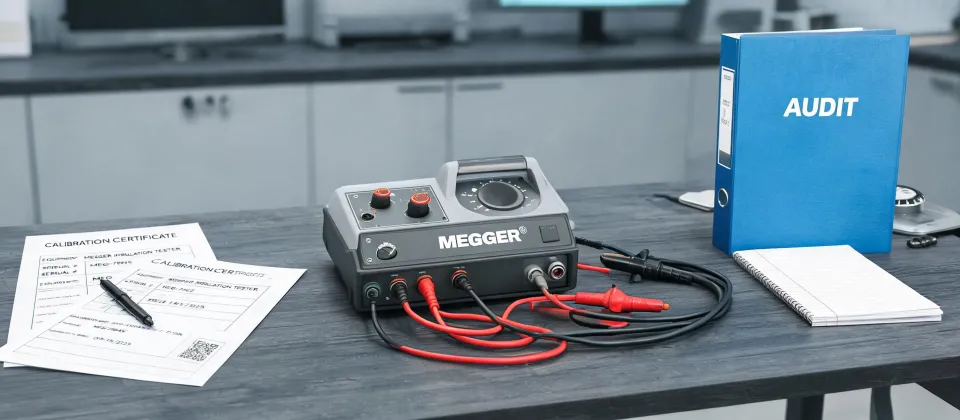
One thing I always tell buyers: don't assume the calibration certificate is included. We've processed orders where the customer assumed the calibration certificate was in the box, but it was an optional extra. The quote said "calibration certificate available on request." The customer's internal auditor didn't care about the quote. That was a painful phone call. A $450 upgrade on a $2,800 order became an unplanned rush charge to get a cert before the audit — and I had to explain the entire thing to my manager. (Note to self: highlight optional calibration on every quote now.)
4. Spectrophotometers and Lab Instruments: Verify the Standard, Not Just the Unit
Spectrophotometers don't fail the same way insulation testers do. Instead of voltage, you're dealing with wavelength accuracy and stray light. If you're using one for QC release, the routine matters more than the brand.
The one thing that trips people up is the reference standard. A spectrophotometer might be perfectly calibrated, but if you're using the wrong reference standard for the method, the results won't match. We had a lab run an entire batch against a quartz cell from a different path length. Every result was garbage. The instrument was fine. The operator was fine. The spec was misinterpreted.
So before you spend time troubleshooting a spectrophotometer, triple-check:
- The cell path length matches the method (10 mm, 50 mm, etc.).
- The wavelength calibration standard is traceable and current.
- The blank contains the same solvent as your samples — including the same lot, if possible. (I've seen a bottle of contaminated blank ruin a whole morning.)
5. Hioki vs Fluke: Pick a Workhorse, Not a Poster Child
This is the step everyone skips. They search "hioki multimeter vs fluke," read a few forum posts, and pick the one their friend uses. That's not a selection strategy.
I've sold and supported both brands. They're both excellent. The right answer depends on your specific environment and application. Here's a practical breakdown:
- Fluke is the default in electrical work. If you need something that's proven in industrial troubleshooting, has a massive ecosystem of accessories, and any electrician on site already knows how to use — pick Fluke. Their customer support and documentation are very strong.
- Hioki tends to be more common in specialized measurement scenarios — power quality analysis, high-accuracy data logging, and applications that require detailed analysis beyond basic voltage and continuity checks. Their multimeters are very well engineered for the price. In some high-precision scenarios, Hioki offers better accuracy for the money than Fluke.
Neither brand is a safe default for the other's niche. A Fluke 87V is a legend in industrial troubleshooting, but if you need high-precision logging for a solar installation study, you may be better served by a Hioki. Ask three questions: (1) What's the highest energy environment it will see? (2) Who's using it — a technician who needs ruggedness or an engineer who needs logging? (3) What does the quality manual require for calibration traceability?
I've also seen buyers assume that if they buy the most expensive model, they automatically get the most accurate measurements for their application. Not the way it works. You need the right model and the right accessories. A $900 meter with the wrong probe is less useful than a $400 meter with the right one.
Final Notes and Common Mistakes
This list isn't exhaustive. My experience is mostly with industrial maintenance teams and mid-sized orders — about 200 significant orders over the years. If you're working in high-voltage utility testing, aerospace, or lab research, your requirements will be different, and you'll need a different level of rigor and documentation.
But the pattern I keep seeing is the same, regardless of the instrument category:
- People skip the spec-reading step and pay for it in rework.
- People ignore calibration status until an auditor asks.
- People trust a digital readout without verifying the test setup.
The cheap insurance is a 12-point checklist before any order. Since I created our pre-purchase checklist, we've caught 47 potential specification errors in 18 months. That's 47 problems that never reached the customer. 5 minutes of verification beats a 5-day correction. And honestly, it also beats the feeling of explaining to your boss why a $3,200 order is wrong.

Marcus Feld
Marcus Feld is an electrical test and measurement analyst specializing in multimeters, oscilloscopes, clamp meters, insulation testers, spectrum analyzers, and data loggers. He applies IEC 61010-2-030 and IEC 61010-031 concepts while examining measurement category, bandwidth, true-RMS response, input loading, and stated uncertainty. His work helps maintenance engineers and test teams choose safe instruments with performance suited to the signals and environments they actually measure.