Test & Measurement
How to Buy Test & Measurement Equipment: Megger Insulation Testers, Zero Speed Sensors, Bimetal Thermometers, and FLIR Thermal Cameras
-
Who Should Use This Checklist
-
Step 1: Define the Actual Measurement Task
-
Step 2: Match the Safety Rating to the Environment
-
Step 3: Confirm the Mechanical and Electrical Details
-
Step 4: Verify Calibration and Certificates Before Checkout
-
Step 5: Ask the Questions That Sound Too Basic But Aren't
-
Step 6: Write It Down for the Next Order
-
Common Mistakes I've Made So You Don't Have To
I'm the office administrator for a 200-person engineering services company. Since 2020, I've managed about $350,000 a year in test equipment and lab supply orders across 15 vendors, and I report to both operations and finance. That means I'm the one who ends up choosing a megger insulation tester device, a zero speed sensor, a bimetal thermometer, or a FLIR thermal camera when an engineer hands me a vague request. This is the checklist I use. It's not the official one from any manufacturer; it's the one that keeps me from buying the wrong thing.
If you're new to purchasing test equipment, this article is for you. I'll walk through six steps, then list the mistakes that cost us time and money.
Who Should Use This Checklist
This is for non-engineers who need to buy electrical test equipment, and for smaller buyers who just need one megger and don't know where to start. If your request includes an electrical insulation tester megger, a zero speed sensor, a bimetal thermometer, or a thermal camera, these steps apply. You don't need an engineering degree. You need to ask the right questions.
Step 1: Define the Actual Measurement Task
From the outside, buying a megger insulation tester device looks easy—it's just a handheld box. The reality is that test voltage and safety rating determine whether it's useful for your job. So before opening a catalog, write down what the instrument will measure, where, and how often.
Megger insulation tester device. A megger, or an electrical insulation tester megger, measures insulation resistance. It applies a test voltage and measures leakage current. The key spec is test voltage: 250V, 500V, 1000V, or 5000V. If you're testing motor windings, 500V or 1000V is common. If you're checking high-voltage cable, you may need 5000V. Don't assume one megger covers everything.
Zero speed sensor. A zero speed sensor detects when a rotating shaft has stopped, even when other parts of the machine are still moving. They show up in conveyors, hoists, and process equipment. Before ordering, you need the supply voltage (usually 10-30V DC), output type (NPN, PNP, or relay), and sensing distance. I once ordered a zero speed sensor without checking the output type. Surprise, surprise—the PLC wanted PNP, and I bought NPN.
Bimetal thermometer. A bimetal thermometer is a mechanical temperature gauge with a dial. Two different metals expand at different rates and move a needle. It's often used in pipes, tanks, and HVAC lines. There's no power needed, which makes it a workhorse. To order one, you need stem length, connection thread, dial size, and temperature range.
What is a FLIR thermal camera? If you typed that phrase into a search box, here's the short version: a thermal camera shows temperature differences as a color image. FLIR—now Teledyne FLIR—is the brand name people often use for any thermal camera, just like megger is often used for any insulation resistance tester. In electrical work, thermal cameras find loose connections, overloaded breakers, and hot components.
After you define the measurement task, note the type of output or display the user needs. Analog dial, digital readout, relay output, or software output—each one changes the part number.
Step 2: Match the Safety Rating to the Environment
For an electrical insulation tester megger, the biggest mistake is ignoring the measurement category. Per IEC 61010-1, handheld electrical test equipment carries a CAT rating. If you're testing inside a panel, you need the rating that matches that environment. A CAT II instrument is for outlet-level work; a CAT IV instrument is for service entrances. Ask an engineer which category applies, then put it on the order.
For zero speed sensors and bimetal thermometers, check the IP rating and ambient temperature. A sensor in a washdown area is not the same as a sensor in a dry control cabinet. An IP67 zero speed sensor costs more than an IP40 version, but if the line gets washed down daily, the IP40 version won't last the year. The same goes for bimetal thermometers in corrosive areas—the wetted material matters.
Step 3: Confirm the Mechanical and Electrical Details
This is where it looks right but isn't. Three things to verify:
- Zero speed sensor: output type (NPN, PNP, or relay), normally open or closed, cable length, connector style, and target material. A sensor that detects steel won't necessarily detect aluminum.
- Bimetal thermometer: stem diameter and insertion length, connection thread (1/2 inch NPT is common), and whether it needs a thermowell. A short stem cannot read the temperature inside a pipe if it doesn't reach the fluid.
- Megger insulation tester device: confirm the test leads, clips, and charger are included. Check lead length. I ordered the right tester once, but the leads were too short for the panel. (Not that I knew at the time.)
If you don't know these details, ask the requesting engineer to fill them in. A vendor can't quote the right unit from a generic description like a round thermometer.
Step 4: Verify Calibration and Certificates Before Checkout
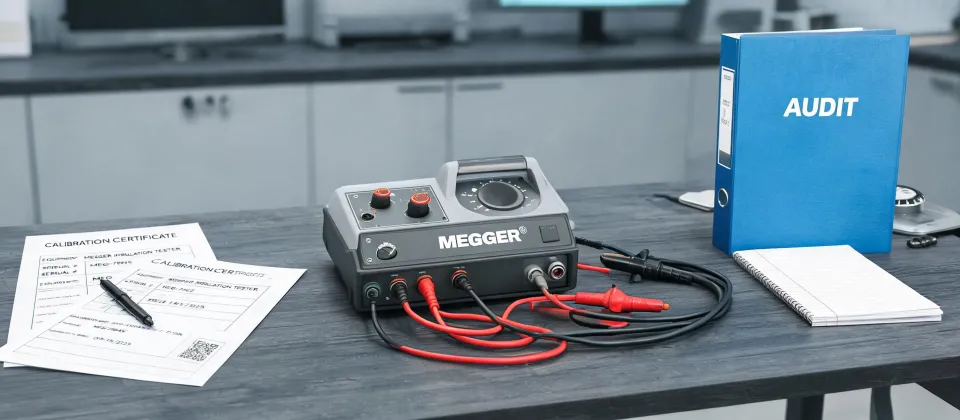
Here's something vendors won't tell you: the first quote often doesn't include calibration. If you're buying a megger insulation tester device for compliance, you'll probably need a NIST-traceable calibration certificate. The same goes for a thermal camera if you're using it to report temperature readings.
I didn't ask once about calibration for a batch of bimetal thermometers. They arrived with a manufacturer's paper, but not the certificate our quality manager wanted. Instead of a one-week order, it turned into a four-week follow-up with the calibration lab. Ugh.
Ask before ordering: Is calibration included? Is it NIST-traceable? What is the validity period? Is there an extra cost per unit? Also ask whether the calibration lab is ISO/IEC 17025 accredited. A certificate from a non-accredited lab may not satisfy your quality team.
Step 5: Ask the Questions That Sound Too Basic But Aren't
I call these the four before you sign:
- What is the true lead time? One vendor said in stock and then took three weeks to ship. For a zero speed sensor replacing a broken one, that meant a machine sat idle.
- What's included? Does the megger come with leads, case, charger, and manual?
- What is the warranty process? Some vendors handle returns; some make you talk to the manufacturer.
- What are the extras? Shipping, customs, calibration, and expedite fees can turn a low quote into a painful one (which, honestly, felt ridiculous).
I know these questions sound like common sense, but I've skipped them when I was in a hurry, and it always came back to bite.
Step 6: Write It Down for the Next Order
The last step is the one almost no one does. When you finally have a good megger insulation tester device, a zero speed sensor that works, a bimetal thermometer with the right thread, and a thermal camera that meets the spec, save the model numbers and specs in your procurement file.
When our company opened a second location in 2024, I had to duplicate the same test equipment. Because I had the spec sheets filed, I spent about an hour repeating the orders. Without it, I would have started from zero.
Include vendor name, part number, date purchased, price paid, and actual lead time. I went back and forth with myself about whether this step was worth the time. It felt like extra bureaucracy. But now it saves me at least six hours on every repeat order.
Common Mistakes I've Made So You Don't Have To
Ordering a megger by name only. Not every megger is the same. An electrical insulation tester megger has a specific voltage range and safety rating. If the request only says megger, ask for voltage and application.
Getting the zero speed sensor output wrong. If the input card expects PNP, an NPN sensor won't work. Classic looks-compatible-but-isn't problem.
Choosing a bimetal thermometer with too short a stem. A shorter stem and smaller dial are cheaper, but the thermometer needs to reach the measured medium. I've made that mistake in a water line.
Buying a thermal camera with too-low resolution. A basic thermal camera with 80x60 resolution can find a hot breaker, but it won't give you a crisp image of a small fuse. For electrical panels, aim for at least 160x120. This gets into engineering territory, so confirm the minimum resolution with the person who'll use it.
Look, I'm not an electrical engineer. I can't tell you the exact CAT rating for your process or the exact thermal sensitivity for a thermography program. That's a conversation for a qualified engineer or vendor.
But buying test equipment doesn't have to be a gamble. Define the measurement task, confirm the safety rating, verify the mechanical details, ask about calibration, and write it all down. Do those six steps and you'll get the right tool the first time—and you won't have to explain a costly mistake to finance. (I learned that one personally.)

Marcus Feld
Marcus Feld is an electrical test and measurement analyst specializing in multimeters, oscilloscopes, clamp meters, insulation testers, spectrum analyzers, and data loggers. He applies IEC 61010-2-030 and IEC 61010-031 concepts while examining measurement category, bandwidth, true-RMS response, input loading, and stated uncertainty. His work helps maintenance engineers and test teams choose safe instruments with performance suited to the signals and environments they actually measure.