Test & Measurement
I Replaced a Load Cell That Wasn't Broken: A $5,000 Lesson in Multimeter Calibration and Megger Testing
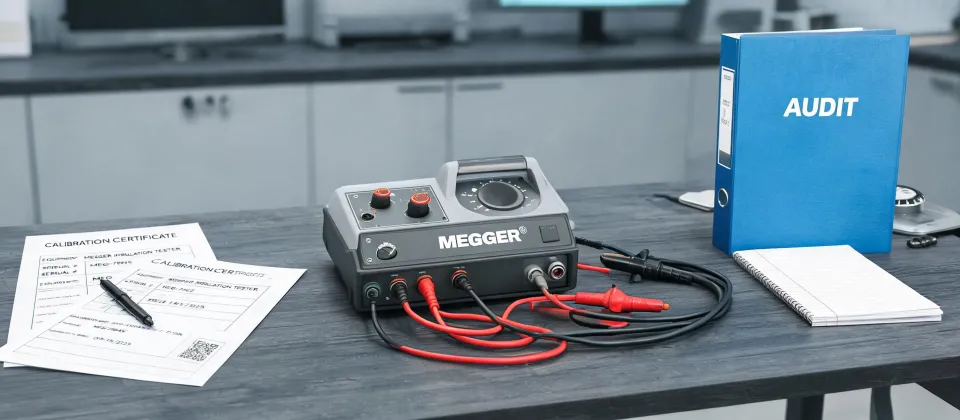
The first sign of trouble was the smell. September 2022, and I was standing next to a 7.5 kW motor that had seized up mid-shift. The bearings were wrecked, the winding insulation was charred in three places, and my insulation test readings from two weeks earlier had said everything was fine. I remember staring at the cheap voltage tester in my hand—the one I'd bought to save $180—and realizing it had been lying to me. More accurately, I'd let it.
I keep a mistake log now. This article is the part I don't normally put in a report: how I skipped multimeter calibration, blurred the line between a multimeter and a proper megger, and replaced a Rice Lake load cell that was never broken. It cost us around $5,000 when I add up parts, labor, and downtime. Write-down of my personal pride? Priceless, but tax-free.
The Budget Decision That Started It All
Back in early 2019, our facility needed an insulation resistance tester for motor winding checks. I was handed the purchase. Everything I'd read said any insulation tester with 500V and 1000V ranges would do the job. So I bought a compact, budget-friendly unit and saved us about $180 compared to a dedicated megger voltage tester. I was proud of that, in the way you're proud of cutting cost before you understand the value of what you cut.
The conventional wisdom is that insulation testing is insulation testing. My experience with that budget unit suggests otherwise. Its readings drifted. The same cable would read 50 MΩ in the morning and 1.2 GΩ after lunch. I thought it was the cable. I thought the motor was degrading. I did not, for one second, suspect the instrument.
That's the first lesson, and it's the one that hurts the most: when a measurement doesn't make sense, your first suspicion should be the instrument, not the asset. But it almost never is.
The Fluke Multimeter Complication
Around the same time, I convinced management to buy a decent Fluke multimeter for general troubleshooting. Another $430 or so. A good investment, in theory.
But here's where I made the second mistake. The Fluke multimeter I chose has an insulation test function. And I'm not going to pretend I didn't search "fluke multimeter megger" online when I was deciding what to buy. I did. It looked like the perfect two-for-one deal. My budget insulation tester was unreliable. The Fluke was trustworthy for voltage and resistance—but its insulation test output isn't the same as a dedicated megger. Different test current, different internal reference, different accuracy profile.
So what did I do? I compared the two instruments against each other. They disagreed. Which one was right? I didn't know. I didn't have a third reference, and neither instrument was recently calibrated. Instead of stopping to figure it out, I averaged the readings and moved on.
The question isn't "which multimeter is better." It's "is this the right tool for this specific test, and is it calibrated?" I answer that question first now. Back then, I answered it never.
The Load Cell That Wasn't Broken
Here's where it gets expensive. October 2022, our mixing area started showing inconsistent batch weights. My first instinct was a faulty Rice Lake load cell on the hopper—a single point load cell that had been in service for five years. I pulled out my Fluke, clipped the leads, and started following what I remembered of the manufacturer's resistance test procedure.
The bridge resistance looked off. It was drifting.
"This load cell's faulty," I told my technician. We ordered a replacement and swapped it out. $400 for the cell, a full day of labor, plus a torn-down line for reconnecting everything.
A week later, the same problem. Now I'm frustrated, and honestly, a little embarrassed. We do a second test. The new cell also reads "drifting." I'm about to call Rice Lake and complain when something stops me: maybe the problem isn't the cells.
It was the multimeter. Its internal reference was out of tolerance, which meant its resistance readings were unreliable. We sent it out for calibration, and the lab report showed exactly that—drift in the reference circuits, failing accuracy. The lab tech wrote "Please re-verify if this device is suitable for the intended measurements" on the report. I deserved that note.
How do you test a Rice Lake load cell correctly? You start by checking your test instrument's calibration status. Then you verify the cell mechanically, then measure the bridge resistance and millivolt output against the spec sheet, and you compare against the manufacturer's published procedure. But honestly, none of that matters if your reference instrument is lying to you. The cell was never broken. I replaced a working part because I trusted a broken tool—and I didn't even know the tool was broken because I'd blown off its calibration.
Calibration Is Boring Until It's Costly
Here's the part that makes me wince. The calibration for that Fluke cost $95 at a local lab with ISO/IEC 17025 scope and NIST-traceable standards. Ninety-five dollars. I'd been putting it off for two years because "it's just a multimeter" and "we've got the budget unit as a backup." The budget unit was the one that had been lying to me for months.
Ironically, the only measuring devices in our facility that had never missed a calibration cycle were the research plus pipettes in our small lab. The lab manager treated pipette calibration the way financial auditors treat expense receipts: absolutely non-negotiable. Why? Because a pipette that measures 10 µL as 9 µL invalidates every result. No one argues with that.
But me and my team? We were making maintenance decisions based on a meter that had drifted, and we didn't have the same discipline. The consequences were an order of magnitude more expensive than a bad pipette reading.
That inconsistency kinda haunts me. We protect the lab instruments and neglect the field instruments—even though the field instruments can cost the facility a lot more when they fail.
What's Different Now
I bought a dedicated megger voltage tester last December. Not the cheapest one, and not another multifunction compromise: a proper insulation tester with a stable test voltage, a logging function, and—this is the part I now insist on—a calibration schedule written into our internal calendar. The Fluke multimeter still lives in my kit, but only for general voltage, current, and continuity work. Somewhere around $500–$900 for the megger, depending on features, based on what I saw from public supplier listings in late 2024.
That's not a small number. But compared to $5,000 in parts, labor, and downtime from the load cell incident? It's an easy trade.
When a reading doesn't make sense, question the instrument first. And if the instrument isn't calibrated, stop working.
We also finally have a policy: any test tool used for maintenance decisions gets a calibration label. If it's out of its window, it goes into a red drawer. Nobody borrows from the red drawer. It's not clever or elegant. It's basic hygiene that costs about $500–$900 a year across our team's instruments. That's cheaper than one mistake.
The Checklist I Use Now
My team doesn't get a lecture from me. They get a whiteboard.
- Is the test instrument within its calibration window? If not, it doesn't get used.
- For insulation resistance, am I using a dedicated insulation tester, not a multimeter's side function?
- Do I have a second reference for safety-critical measurements? Check against it, but don't average—investigate the difference.
- Is my instrument suitable for the signal level I'm measuring? A load cell's millivolt signal isn't a wall outlet voltage.
- If the reading is unexpected, run the test again immediately. Then run it with another instrument. Then—and only then—question the asset.
The whiteboard went up in January 2023. In the first twelve months, we caught seven "errors" that turned out to be instrument issues, not asset issues. Seven times we didn't replace parts that weren't broken. The board paid for itself many times over, though the real math is a bit fuzzy.
What I'd Tell Someone Starting Out
If I could go back to early 2019, I'd tell myself three things.
First, "megger" is a verb and a brand and a category of instrument, and you should own the category, not the shortcut. A genuine megger voltage tester is a specific tool with a specific job. A multimeter with an insulation-test mode is two functions in one device, and each function makes compromises for the other.
Second, calibration is not a paperwork exercise. It's the difference between making decisions based on reality and making decisions based on an instrument's opinion. And you can't tell it's an opinion until it disagrees with reality—which is exactly when you can least afford it.
Third, honestly, there's no single "best" brand or model for everyone. I use a dedicated tester now and I prefer it. But if you're mainly doing basic continuity checks and occasional troubleshooting, a good brand—whatever the brand—with a current calibration label and a documented maintenance schedule might genuinely be enough. Know the difference between "enough" and "right." For insulation resistance testing, I now buy "right." I learned that distinction from a $95 calibration report.
The load cell is still in service, by the way. The one I almost threw away? The testing technician who came to help us bench-tested it while we were waiting for the replacement shipment. It passed every metric. Sitting in my office, labeled "NOT FAULTY—DO NOT DISCARD." I keep it around as a reminder that the instrument is the first thing to question, and the last thing we think to check.
Saving $180 on the wrong tool cost us about $5,000 in parts, labor, and downtime before the lesson finally stuck. I hope sharing this saves you from paying it yourself.

Marcus Feld
Marcus Feld is an electrical test and measurement analyst specializing in multimeters, oscilloscopes, clamp meters, insulation testers, spectrum analyzers, and data loggers. He applies IEC 61010-2-030 and IEC 61010-031 concepts while examining measurement category, bandwidth, true-RMS response, input loading, and stated uncertainty. His work helps maintenance engineers and test teams choose safe instruments with performance suited to the signals and environments they actually measure.