Test & Measurement
Stop Blaming Your Test Instruments: What an Office Admin Learned About Megger, Calipers, and Load Cells
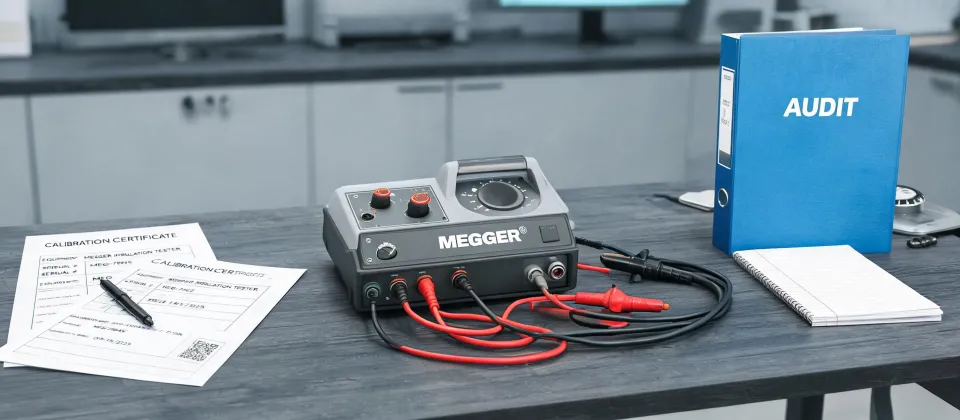
If you've ever had a maintenance supervisor stand at your desk holding a dead thermometer probe and an inspection deadline, you know the exact feeling I mean. I'm the office administrator for a 180-person manufacturing company. I manage all lab and maintenance ordering—roughly $260,000 annually across 12 vendors. I report to operations and finance. I'm not an engineer. But after five years of buying test instruments, I've learned more about total cost of ownership than I ever wanted to know.
When I took over purchasing in 2020, I assumed the lowest quote was always the best choice. Three budget overruns later, I learned about total cost of ownership. But the deeper mistake was treating every request as a product transaction. Let me show you what I mean.
In 2022, the maintenance team asked for megger insulation testers for an electrical contractor project. On paper, the unit we picked had the right ranges and CAT III safety rating. On the job, the crew kept complaining about inconsistent readings. I wanted to blame the tool. The real issue turned out to be a mismatch between the test voltage settings and the cable type they were testing. Another assumption, my mistake.
In 2023, we bought a digital vernier caliper for a precision machining cell. It reported 0.005 inches off from the coordinate measuring machine (CMM) reading. The client held up production. We looked like idiots. The caliper wasn't broken—it just wasn't the right tool for that tolerance environment.
And then there was the request that broke me. My facilities manager sent an email with the subject line "Help." The body said: how to troubleshoot a Rice Lake load cell? Not a purchase order. Not a part number. A question. He didn't need a new load cell; he needed a procedure, a wiring diagram, and a multimeter reading. I had no idea how to answer, and our regular supplier wasn't helpful either. (Surprise, surprise.)
The Surface Problem: It's Tempting to Blame the Equipment
That's the surface problem: a requisition comes across your desk, you find a product that matches the keywords, you get a good price, and the order goes through. When it fails later, everyone blames the gear. But the gear didn't design the purchase.
Here's what you need to know: test instruments are not commodities. Two devices with the same listed measurement range can behave completely differently in the field. A digital vernier caliper with a cheap encoder and a digital vernier caliper with hardened stainless jaws, IP54 protection, and a NIST-traceable certificate are not the same product. They look the same in a photo. They don't perform the same on a shop floor.
The same logic applies to megger insulation testers. The phrase "insulation tester" covers a huge range: handheld megohmmeters, microprocessor-controlled testers with polarization index and dielectric absorption ratio, power quality analyzers that happen to measure insulation as one function. If you buy purely on price, you'll get something that works in ideal conditions. Field conditions are never ideal.
The Deeper Problem: Buying Specs Without an Outcome
When my facilities manager asked how to troubleshoot a Rice Lake load cell, the honest answer wasn't a part number. It was a procedure. According to Rice Lake Weighing Systems' documentation (ricelake.com), the first step is checking the excitation voltage and the signal wiring. Then you verify the junction box for moisture, check the millivolt output with no load, and only then start suspecting the cell. That's the kind of answer our regular supplier should have been able to give. They couldn't.
That gap—between a product and an outcome—is the deeper problem. "We need a thermometer probe" isn't a product request. It's a requirement for a specific accuracy class, tip style, response time, and calibration traceability. "We need a megger power quality analyzer" isn't just a box with a display. It's a decision about voltage ranges, current clamps, logging memory, and whether your facility's wiring is single-phase or three-phase.
A good supplier asks those questions before you buy. A bad supplier waits until after you complain.
In March 2024, we needed a megger power quality analyzer for a scheduled energy audit. The audit contract was worth $15,000. Finance wanted me to use a vendor whose quote was $400 cheaper but couldn't commit to a delivery date. I paid $400 extra for expedited delivery from a distributor that guaranteed it in three days (which, honestly, felt like a lot for one box). The alternative was missing the audit window and rescheduling for two months later. It was a no-brainer.
The "local supplier is always faster" thinking comes from an era before modern logistics. A well-run specialized distributor can often beat a local general supplier—if they have the product in stock and a real shipping promise. The local shop may be closer, but if they don't have the item, close doesn't matter.
That's when I stopped treating "fast" as a nicety and started treating certainty as part of the spec. It's also when I stopped trusting the phrase "usually ships within a week." Usually isn't a date. A commitment is a date.
What the Wrong Purchase Actually Costs
Let's talk about cost, because that's what finance actually cares about. The wrong test instrument doesn't just waste the purchase price. It creates three cost layers:
- Downtime and rework. When a digital vernier caliper gives a bad reading, the part gets machined wrong. You don't notice until assembly or a customer inspection. The rework cost is usually many times the $80 you saved on the caliper.
- Compliance and safety risk. Insulation testers are safety tools. Per IEC 61010-1 (available from the IEC Webstore), test equipment used in overvoltage categories needs to meet specific transient withstand requirements. If you buy the cheapest unit without checking its category rating, you're not saving money—you're betting someone's safety.
- Missed deadlines and credibility damage. The energy audit story above is a perfect example. A $400 rush fee looks stupid in a budget review until you explain the $15,000 contract and the customer relationship it saved.
No one in operations wants to hear a procurement person talk about total cost of ownership. They've heard it before. But after being burned twice by "probably on time" promises, I now ask three questions before every instrument order:
- What is the exact application and environment? Not "insulation tester"—"insulation tester for 480 V motor cables in a washdown area."
- What accuracy, calibration traceability, and certification do we need?
- What delivery date can they actually commit to, and what's the cost to make it a guarantee?
What Finally Worked (Short Version)
After five years, here's the condensed answer. I stopped buying test equipment like office supplies and started buying from suppliers who act as an extension of our engineering team. That means they can explain the difference between a megger insulation tester and a low-voltage continuity tester. They can tell you why a megger power quality analyzer needs detachable current clamps for the kind of panel you're testing. They can send the calibration certificate before you ask. And when you call with a baffling load cell question, they don't say "we don't support that." They say "here's the wiring diagram and the first thing to check."
Bottom line: the problem was never that the equipment was bad. The problem was that I was buying products instead of outcomes. If you're an admin or procurement person who's been blamed for a "bad" instrument, look at how the purchase was made. Was the application defined? Was the spec verified? Was the delivery a commitment or a guess? Was the supplier able to answer the next question?
Take it from someone who learned the hard way: certainty is a spec. Write it down, pay for it when it matters, and you'll save yourself the conversation I had with my VP after a machine sat idle for four hours waiting for a load cell diagnostic. (Trust me, you don't want that conversation.)

Marcus Feld
Marcus Feld is an electrical test and measurement analyst specializing in multimeters, oscilloscopes, clamp meters, insulation testers, spectrum analyzers, and data loggers. He applies IEC 61010-2-030 and IEC 61010-031 concepts while examining measurement category, bandwidth, true-RMS response, input loading, and stated uncertainty. His work helps maintenance engineers and test teams choose safe instruments with performance suited to the signals and environments they actually measure.