Test & Measurement
When a Dead Conveyor Forced Me to Learn About Megger Resistance Testers
It Started With a Dead Conveyor Line
Last spring, on a Tuesday that was supposed to be routine, one of our conveyor lines just stopped moving. The maintenance electrician came to my desk with a printout from the PLC and said, "We need a sensor for conveyor monitoring – probably an inductive proximity switch. And I need an insulation tester to check the motor windings before we power anything back up."
I should tell you, I'm not an engineer. I'm the admin who handles purchasing for a 120-person plant. Every year, I process maybe 70 orders across 8 vendors – everything from office supplies to calibration services. I've learned to read specs, but that day, I had to admit I wasn't sure what an insulation tester does, why it's called a megger, and whether a $200 sensor from a generic brand was the same as a $400 one from Balluff.
The Rookie Mistake That Cost $350
My first instinct was speed. The line was down, and everyone was looking at me. So I found an inductive sensor that seemed to match the existing bracket dimensions. The price was right – $180, about 30% cheaper than the other two quotes. I ordered it with next-day shipping.
It arrived the right day, and it was dead on arrival. Not literally broken, but the mounting holes were 2 mm off, and the cable length was exactly 0.5 meters too short. That was my classic rookie mistake: assuming "standard mounting" meant the same to every manufacturer. It doesn't.
The real kicker? The vendor's return policy said "returns on non-stock items require a restocking fee of 20%." They also didn't offer any technical support – just an email address that got back to me two days later. The sensor is sitting in our parts drawer now, a $350 lesson (including shipping and restocking) in why it's dangerous to buy test equipment on price alone.
The most frustrating part of that whole episode? You'd think a written spec sheet would prevent exactly this kind of mix-up, but interpretation varies wildly. To be fair, maybe I should have called first. But I didn't.
Finding the Right Megger Resistance Tester
After that debacle, I told the electrician we needed to be more careful. He explained that the motor on that conveyor had been tripping the overload relay intermittently, and he suspected a winding fault. "I could use a regular multimeter," he said, "but it's easier to see a few megaohms of leakage with an insulation tester – a megger. That'll tell me if the varnish is breaking down."
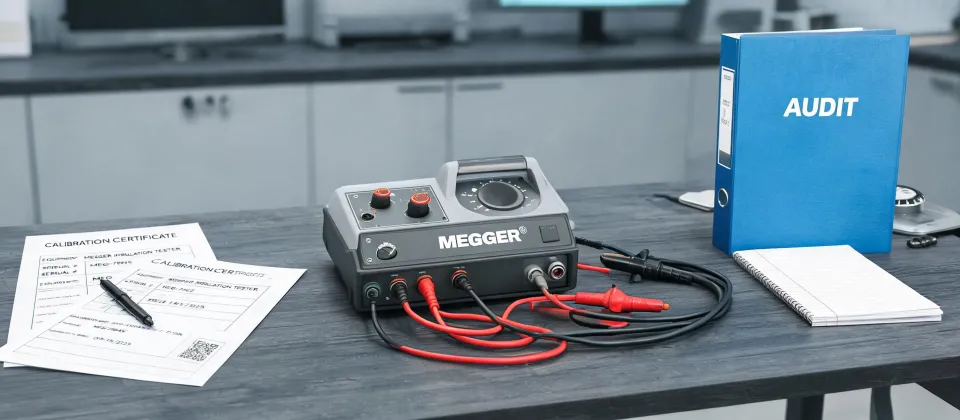
Working with our maintenance team, I searched for "megger resistance tester" and quickly realized that megger isn't just a generic term – it's a brand name by Megger, and it's also the common name for any insulation resistance tester. The applications range from simple handheld models to megger 15kv insulation testers used on high-voltage cable. Our 11 kV feed line had been subject to several recent outages, so the electrician argued we should get a 15 kV model while we were at it.
That felt like a lot. Honestly, I'd come in expecting to buy a $500 instrument. Turns out a 15kV insulation tester can go for $4,000-$6,000. (Based on actual quotes I collected between February and March 2025 – prices shift with distributor, features, and calibration.) So I started asking around.
One distributor said, "We don't sell those to small accounts." Another gave me a quote but couldn't offer any training or application advice. Then I talked to a smaller distributor who actually called me back.
"What are you going to test?" she asked. Not "what's your credit line?" She walked me through the differences between a Megger brand model and a competitively priced equivalent. She noted that for our expected testing routine, we'd need a 5 kV model for most motor checks, but if we planned to verify the 11 kV cable, we'd want the 15kV unit. She also explained that IEEE 43 recommends insulation testing at specific voltage levels depending on the equipment voltage rating. (Source: IEEE 43-2013, "IEEE Recommended Practice for Testing Insulation Resistance of Electric Machinery.")
That conversation changed how I think about test equipment suppliers. She wasn't trying to upsell me – she was trying to match the instrument to the job. And when she found out I had a small lab budget, she didn't treat me like a second-class customer. She quoted the pro-level model and a simpler one, and she let me decide.
In the end, we didn't buy the 15kV meg. We rented a megger 15kv tester for the one-off cable test and bought a 5kV insulation tester for daily troubleshooting. That's been the right balance.
What About Balluff Sensors?
That brings me back to the sensor question. I'd asked around: "Is Balluff a good brand for sensors?" It's actually a great question, and I wish I'd gone deeper.
In my experience, Balluff is a solid manufacturer. Their inductive sensors are well-built and consistent. But "good brand" doesn't mean "right model." Our application on the conveyor had a particular housing style, a shielded part, and a specific sensing range. I had to match the exact specs, not just the brand name.
The small distributor who helped me with the Megger also carried Balluff. She checked the existing mounting bracket, recommended an equivalent model, and sold it to me for less than the big distributor had quoted. The order was maybe $190. She treated it with the same seriousness as the $4,000 tester. That impressed me more than I can say.
Benchtop Multimeter – A Side Lesson
While I was at it, our lab supervisor asked for a benchtop multimeter to replace an old Fluke (no complaints about Fluke – that unit lasted 20 years). I looked at a few tabletop models, realized that specs like accuracy and resolution are more important than fancy displays, and bought one from the same distributor. It's been reliable so far.
But the key takeaway was about selection guidance. I'm not an engineer; I need a supplier who can translate "I need to check a motor winding" into "here's the right megger resistance tester." The big online catalogs just give you a list. A good distributor asks you questions.
Lessons I'd Share With Another Admin Buyer
If you're the person stuck buying test equipment for a plant (or any technical gear), here's what I learned:
- Small orders are not worth an outsourcing vendor. If a supplier treats a $200 sensor order with contempt, they'll treat your $5,000 order worse.
- Total cost includes downtime. Cheaper part that doesn't fit? You've lost production time, plus your own time. The real price was $350, not $180.
- Ask about technical support before you order. A supplier who answers questions proactively is worth far more than one who saves you $30.
- Megger vs insulation tester – both are common names, but you need the right voltage rating and leads. If in doubt, ask.
- Good brand ≠ right model – particularly for sensors like Balluff. Standardization doesn't mean universality.
That dead conveyor ended up being a blessing in disguise. I now know a little more about insulation testing, a lot more about vendor behavior, and I've found a distributor that takes my $200 orders just as seriously as the big ticket items. That's not just good service – it's the kind of relationship that pays off when you're stuck in a Tuesday-morning crisis.
So, if you're in the same position? Take the time to find a supplier who respects the question "Is this the right tool for the job?" Even if it's a small order. It makes all the difference.

Marcus Feld
Marcus Feld is an electrical test and measurement analyst specializing in multimeters, oscilloscopes, clamp meters, insulation testers, spectrum analyzers, and data loggers. He applies IEC 61010-2-030 and IEC 61010-031 concepts while examining measurement category, bandwidth, true-RMS response, input loading, and stated uncertainty. His work helps maintenance engineers and test teams choose safe instruments with performance suited to the signals and environments they actually measure.