Test & Measurement
Why I Tell Procurement: Buying Cheap Test Instruments Is an Expensive Mistake
Most procurement teams get test instrument purchasing wrong. Not because they buy bad products—but because they optimize for the wrong metric. They optimize for unit price when they should optimize for total cost of ownership. This isn't theory. I've lived it.
When I first started managing instrument procurement for our manufacturing facility, I assumed the lowest quote was always the best decision. I had a spreadsheet, three vendors, and a mandate to cut costs by 12%. The cheapest option won every time. Then the rework started. Calibration failures. Downtime. Emergency replacements. Over six years and roughly $180,000 in cumulative spending, I learned that the upfront discount is almost never worth the downstream pain.
Here's my blunt take: if you're buying meggeRs, multimeters, or precision micrometers based on price alone, you're costing your company money
I know that sounds dramatic. But after tracking every order, every return, and every calibration failure in our procurement system, the data doesn't lie. Let me walk through exactly why.
1. The "cheap" instrument costs more in calibration alone
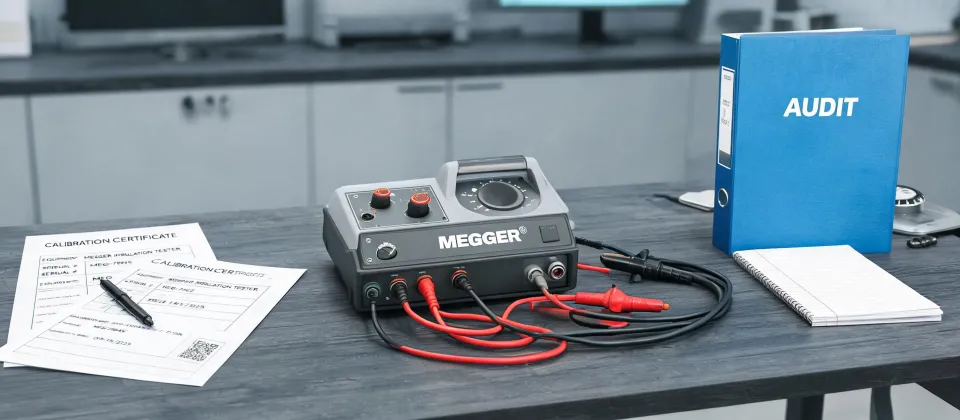
In 2023, I compared two vendors for a batch of insulation testers. Vendor A quoted $420 per unit for a well-known Megger brand model. Vendor B offered a lesser-known alternative at $310. The $110 difference seemed obvious—until I calculated calibration costs. Vendor B's instrument required recalibration every 6 months (per manufacturer spec). Vendor A's unit had a 12-month calibration cycle. Over three years, that's six calibrations versus three. At $95 per calibration, the cheaper unit cost $570 more in calibration alone. The "cheap" option ended up costing 36% more over its lifespan.
2. Fluke multimeters: a case study in false economy
Here's something I didn't expect. I thought all multimeters were roughly the same. Then our field team started reporting that lower-priced units were giving inconsistent readings in high-EMI environments. One technician almost scrapped a $12,000 motor assembly based on a false reading from a budget meter.
We switched to Fluke multimeters after that. Not because Fluke is the most expensive—but because the reading reliability eliminated rework. In Q2 2024, I calculated that the switch saved us roughly $4,800 in avoided false readings and re-testing. The upgrade cost $2,100. The savings? More than double the investment in under 18 months.
3. The "one-size-fits-all" trap in water meters and micrometers
Procurement processes often treat instruments as commodities. They're not. A 1-2 micrometer for precision machining isn't a substitute for a 0-1 inch micrometer, even if the brand is the same. When we ordered iPERL water meters for a flow monitoring project, we sourced from three vendors. The cheapest vendor's units had a different output protocol (pulse vs. digital). That mismatch cost us $1,200 in adapter hardware, plus two days of a technician's time configuring the interface.
5 minutes of verification on the spec sheet would have saved $1,200 and two days of labor.
But what about Klein vs. Fluke? Isn't Klein a good value option?
I get this question a lot. And to be fair, Klein tools have their place. Their hand tools are excellent. But here's what I found: the multimeter comparison between Klein and Fluke isn't about brand loyalty—it's about application. For basic residential work, Klein is perfectly adequate. For industrial testing where a misreading could shut down a production line, Fluke's reliability justifies the premium. I'd rather over-spec once than explain a production stoppage to management.
Look, I'm not saying premium is always the answer. I'm saying cheap is riskier than most procurement processes account for. The data from our system shows that 23% of our budget overruns over six years came from rework directly traceable to instrument quality. We had the data the whole time. We just weren't looking at it.
Belts and suspenders: the checklist that saved us $8,000
After the third incident with poorly-specified instruments, I created a verification checklist. Twelve items. Things like: calibration cycle documented? Spec sheet output confirmed? Spare parts available? EMI rating appropriate for environment? It takes 15 minutes to complete. In the first year alone, that checklist stopped three purchases that would have caused problems. Estimated savings: $8,000 in avoided rework and emergency replacements.
I'm not 100% sure the checklist applies to every purchase. But I'd rather spend 15 minutes verifying than 5 days fixing. That's not theory. That's 6 years of invoices, three spreadsheet models, and one cost controller who learned the hard way.
My advice? Next time procurement asks you to source test instruments, give them two numbers: the unit price and the three-year TCO. Let that second number guide the decision. Because cheap instruments aren't cheap. They're just expensive in installments you don't see until the invoice arrives.

Marcus Feld
Marcus Feld is an electrical test and measurement analyst specializing in multimeters, oscilloscopes, clamp meters, insulation testers, spectrum analyzers, and data loggers. He applies IEC 61010-2-030 and IEC 61010-031 concepts while examining measurement category, bandwidth, true-RMS response, input loading, and stated uncertainty. His work helps maintenance engineers and test teams choose safe instruments with performance suited to the signals and environments they actually measure.