Test & Measurement
A 36-Hour Rush Order: What a Megger MIT220-EN and a Fluke vs. Klein Multimeter Question Taught Me
It was 4:47 PM on a Thursday in March 2024 when the phone rang. I remember the time not because I have a memory for details — we logged it. All emergency calls get logged, and this one went into the system as "Priority 1: plant shutdown pending."
The caller was an electrical maintenance supervisor at a food processing plant about an hour from our distribution center. He didn't bother with pleasantries.
"Our megger is dead. A technician dropped it off a ladder, and the display is showing nonsense characters. We've got a mandatory shutdown window starting tomorrow night, and the switchgear and motor feeders need insulation testing before Monday's start-up. If we're late, corporate says it's a $50,000 penalty."
I'm a senior applications specialist at an industrial test instrument distributor. In seven years, I've coordinated close to 50 rush orders — some as small as a $500 cable locator, a few as large as $15,000 in calibration equipment. But this one had a hard clock on it. The first question in a situation like this isn't "what do they need?" It's "how many hours do we actually have?" The second is whether the tool we send is the right one. The third is what happens if it isn't.
What the Client Actually Needed
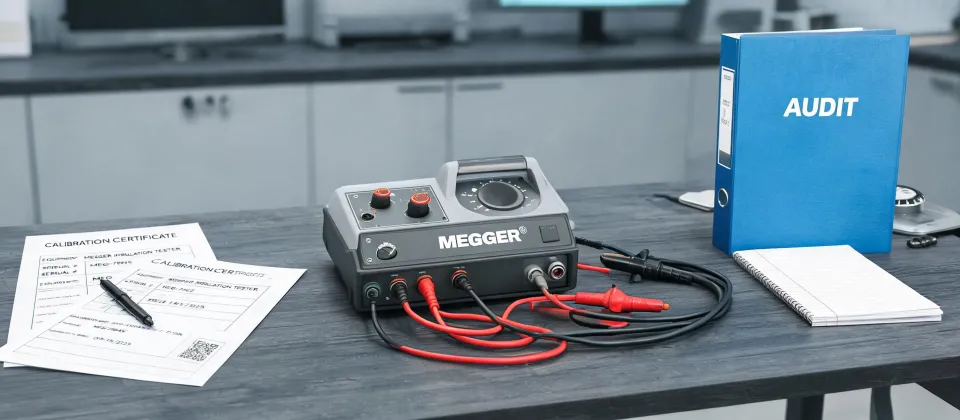
The supervisor asked for a replacement Megger MIT220-EN handheld insulation tester. That's about as specific as a request can get, which is refreshing — a lot of panic calls start with "give me something that checks cables." The MIT220-EN is a battery-powered insulation tester that applies test voltages of 250V, 500V, or 1000V and measures insulation resistance up to 200 gigohms. In plain terms: it stresses cable and motor-winding insulation at a much higher voltage than a multimeter can produce, and tells you whether the insulation is still holding up. There's no shortcut for that with a regular meter.
He also wanted a Megger TPT420 voltage tester — the two-pole unit with a CAT IV 600V rating, the one his crews use to confirm a circuit is actually dead before they open a panel.
Both are standard pieces of kit. In a normal world, this would be a 5-to-7 day order, ground shipping, no urgency. But we weren't in a normal world that day.
Then, right before he hung up, he added the part I wasn't expecting:
"We're also putting together maintenance kits for the new shift. Is the multimeter 179 worth the money? And my younger techs keep asking if they should buy a Klein instead of a Fluke."
The Stock Screen Lied
Here's what I should have done the moment he asked for the MIT220-EN: walked to the shelf and physically checked the box. Instead, I looked at the inventory screen, saw "on hand: 3 units," and thought, what are the odds?
The odds caught up with me.
Those three units were sitting in the calibration-return bin. They'd come back from their annual calibration that afternoon, and the status in the system hadn't been updated. They were not cleared for sale. For about ten minutes, we had a very serious problem with an eight-hour deadline.
This is where rush orders get misunderstood. From the outside, an emergency order just looks like working faster. The reality is it means checking the physical shelf, not the screen. Making calls to five outside distributors in under an hour. Convincing one of them to do a parking-lot pickup after closing because their warehouse staff had already left. Paying about $120 for a courier run that would have cost $18 in normal shipping. Then telling the dispatcher to send the driver straight to the client's site instead of back through our dock, which saved about 45 minutes — the kind of shortcut you only learn after coordinating a few dozen of these.
We found one MIT220-EN about 60 miles out. I want to say the price came to around $640, though I might be misremembering by a few dollars — the unit has been ranging between roughly $590 and $680 across major online distributors as of January 2025, if that helps with budgeting. We paid on a company card without waiting for a purchase order, because the PO could wait but the shutdown could not.
The TPT420, it turned out, was in our own stock after all. I verified that with my own hands, not the screen. One of our staff drove it out to the client's gate and handed it to the security guard by 8:15 PM.
With the physical inventory sorted, I could finally give the supervisor a real answer to the question he'd dropped on me.
Fluke vs. Klein Multimeter: The Question That Deserves a Straight Answer
The Fluke vs. Klein multimeter debate never really goes away. I hear it from electricians, engineers, and even plumbing contractors. It deserves better than a shrug.
I sell instruments, so take my bias with a reasonable grain of salt. But I'd rather spend ten minutes explaining why a $500 meter is worth it than deal with a mismatched tool and a frustrated customer later.
The Fluke 179 is a true-RMS digital multimeter with 0.09% basic DC accuracy, CAT III 1000V / CAT IV 600V safety ratings, and a track record so established that it's effectively the default meter in industrial plants. The list price is around $450–500 in the U.S. market as of early 2025 — but don't hold me to that, prices move. For a maintenance tech who troubleshoots VFDs and works inside live panels, the true-RMS measurement is the key feature. VFDs produce noisy, non-sinusoidal signals, and a budget meter will happily give you a confident reading that's wrong. A confidently wrong reading can burn an entire shift chasing a phantom fault.
Klein makes genuinely good multimeters for the money — most fall in the $50–120 range depending on features. They're perfectly fine for residential wiring, continuity checks, and checking receptacles. At least, that's been my experience with the Klein units that pass through our store. But when a production line is down and every hour costs more than the meter, you don't want a "probably right" reading. You want the Fluke 179's accuracy, stability, and — not insignificantly — its ability to survive a five-foot drop onto concrete. That's not a marketing claim. That's a scar on the floor of our workshop from an incident in 2023.
"Probably right" is the enemy of good troubleshooting. The Klein will probably tell you what you need to know. The Fluke will tell you the truth, and it'll still be working after you knock it off a ladder.
So my answer was simple: put Fluke 179s in the plant kits. If the junior tech wants a Klein in his personal toolbox for weekend projects, that's a reasonable buy. Just don't make a Klein your only meter when the work is critical.
A Digital Depth Micrometer Is Not a Caliper
That handled the multimeter side. The depth micrometer was a different kind of problem.
He'd asked for a digital depth micrometer — a 0–25 mm / 0–1" model — but he'd hesitated, because one of his machinists argued that a digital caliper could measure depth just as well, and they already had calipers on the shelf.
That "one-tool-does-it-all" thinking comes from an era when instruments were simpler. Today, a caliper and a depth micrometer are not interchangeable. A caliper can reach into a recess, sure, but the beam isn't rigid enough and the base isn't stable enough for reliable depth readings. And the resolution gap is real: a typical digital caliper reads to 0.01 mm, while a proper digital depth micrometer resolves to 0.001 mm — a full order of magnitude finer. On a valve seat or a bearing housing bore, that difference is the line between a part that fits and a part that gets scrapped.
We configured a 0–25 mm / 0–1" digital depth micrometer, added a calibration certificate, and put it on the same overnight run as the Fluke. The price landed around $120, though it varies by brand and resolution — verify current pricing before you quote it.
The supervisor was mildly annoyed that I wouldn't let him save $60 by "just using a caliper." That annoyance turned into a short message a few weeks later: the machine shop had held a 0.002 mm tolerance on a repaired component using that depth mike. The $60 saving would have cost a lot more in rework.
What Monday Morning Taught Me
The plant went down Friday night as scheduled. The crew used the Megger MIT220-EN to insulation-test the motor feeders and switchgear at 500V and 1000V, used the TPT420 to verify dead circuits before opening any covers, and put the Fluke 179s into the new maintenance kits. The depth micrometer went to the shop.
Monday at 6:13 AM, the supervisor called. Start-up went smoothly. No faults, no surprises, no $50,000 penalty. A week later, his department sent a purchase order for two more MIT220-EN units, a backup TPT420, and three additional Fluke 179s as their new standard kit.
That follow-up order was bigger than the rush order. But the trust behind it was earned in those 36 hours — not because we worked fast, but because we checked what needed to be checked and told the customer the truth even when the truth was inconvenient.
Three lessons I keep re-learning from calls like this:
An informed customer asks better questions and makes faster decisions. If the supervisor hadn't asked about Fluke vs. Klein, and if I hadn't pushed back on the caliper substitute, he would have bought cheaper tools and gotten worse results. Helping customers understand the difference isn't a favor — it's the job.
Brand matters less than application. Megger makes insulation testers. Fluke makes multimeters. Klein makes solid budget meters. They're not interchangeable. The right tool is the one matched to the job, the environment, and the cost of being wrong.
A rush order tests verification, not speed. The $120 courier fee, the after-hours calls, the parking-lot handoff — all of it is rounding error compared with the cost of a crew standing around waiting for the right model to arrive. Or worse, the cost of the wrong model arriving on time.
And the honest version of all of this? Every time I catch myself thinking a rush order will probably be fine, that's the moment I slow down and double-check. The odds always catch up eventually. That Thursday evening, they almost did.

Marcus Feld
Marcus Feld is an electrical test and measurement analyst specializing in multimeters, oscilloscopes, clamp meters, insulation testers, spectrum analyzers, and data loggers. He applies IEC 61010-2-030 and IEC 61010-031 concepts while examining measurement category, bandwidth, true-RMS response, input loading, and stated uncertainty. His work helps maintenance engineers and test teams choose safe instruments with performance suited to the signals and environments they actually measure.