Test & Measurement
Efficiency Is the Real Test: Why the Megger MIT310 Digital Insulation Tester Changed My Mind
Here's an unpopular opinion: most instrument problems aren't really instrument problems. They're process problems. And the faster you digitize your test workflow, the faster those problems surface—before they cost you a customer.
I'm a procurement and technical support lead handling test-and-measurement orders for B2B customers. Seven years in. I've personally made and documented 14 significant mistakes, totaling roughly $12,000 in wasted budget. Now I maintain our team's checklist so nobody else repeats my errors.
In my first year, 2017, I made the classic mistake: I ordered a batch of insulation testers based on price alone. On paper, they were fine. In practice, the analog scale was hard to read, and the operator had to interpret the needle position. That ambiguity came back to bite us in September 2022, when we submitted test records for a 14-piece order. Every single reading was questioned because two different techs had read the same needle differently. The redo cost $890 and a one-week delay—and we still lost the credibility battle.
That's when I switched to a digital insulation tester megger and started treating measurement as a data problem, not a needle-reading exercise.
The case for a digital insulation tester megger
I know megger gets used loosely. Around here, it's both the brand name and the generic shorthand for an insulation resistance tester. But the important distinction is digital versus analog, not brand versus brand.
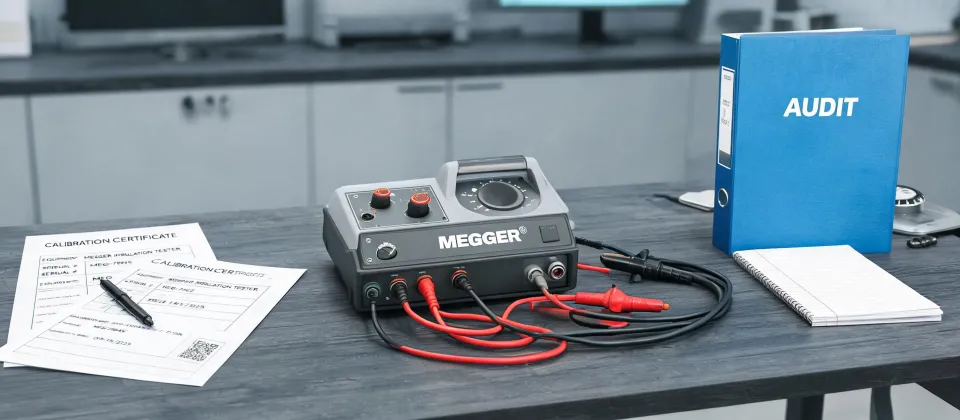
After the 2022 incident, we bought the Megger MIT310 digital insulation tester. It wasn't the cheapest option, and I'll be honest: I hesitated. But within two weeks, the argument was over. The MIT310 stores readings, shows the actual resistance value numerically, and cuts off any debate about where the needle was. On a job that had previously required two people to double-check, one person was enough.
Now, I'm not saying analog instruments are useless. They still make sense for quick go/no-go checks and for techs who've used nothing else for 20 years. But if the measurement has to be recorded, compared, or audited, a digital unit wins every time. It's not about being fancy. It's about repeatability.
Switching to the digital routine cut our turnaround from five days to two. That's not a minor improvement. That's the difference between getting the job and missing the deadline.
A Teledyne thermal camera should be in the conversation
The most frustrating part of measurement mistakes: they don't announce themselves. You'd think a failing connection would fail loudly, but more often it fails quietly—a borderline reading, a warm spot, a component that just doesn't look right.
We had an intermittent trip in a distribution panel that drove us crazy for a week. The contact probe said everything was normal. Then we used a Teledyne thermal camera to scan the panel under load, and the camera showed a busbar connection running about 30°F hotter than its neighbor. That was the problem. The loose connection was there all along—we just weren't looking at the right information.
I still kick myself for not using the Teledyne thermal camera earlier. It had been sitting on the shelf for months. The scan took twenty minutes and paid for the camera in one afternoon.
Thermal imaging is not a replacement for electrical testing. It's a different lens. But if you're already buying test instruments for industrial work, a thermal camera is more of a no-brainer than people think. You'll find problems you didn't know existed.
Calibration is where the money actually goes
The other thing that doesn't show up on a purchase order is calibration. Our worst write-off was a set of temperature readings taken with a 52 II thermometer that was off by about two degrees. We used it for a process verification report. The customer's quality engineer asked for the calibration certificate. We didn't have one. The $3,200 order went straight to the trash.
That's when I learned that a measurement without a traceable baseline isn't a measurement. It's a guess with a number attached.
Since then, I've systematized checks for every instrument. If you've ever looked up how to calibrate Mitutoyo micrometer, you know the procedure isn't exactly hard—but it's easy to skip when production is waiting. A micrometer can drift, and a drifted micrometer makes hundreds of bad parts before anyone notices.
We now have a pre-check list for micrometers, thermometers, insulation testers, and thermal cameras. In the past 18 months, that list has caught 47 potential errors. 47. Most of them were simple issues: a dead battery, a missing calibration sticker, a probe with a damaged lead. But catching them before a shipment goes out is worth far more than fixing them after.
What about the old-school purists?
You might say that for a simple check, the old tools are fine. Honest answer: for a simple check, they're fine. But the moment you need proof—and in B2B you almost always need proof—you'll spend more time defending unclear readings than you saved on the purchase.
I can only speak to my context: mid-size orders, 50-plus instruments in active rotation, customers who audit. If you're a solo electrician doing one motor test a month, the calculus might be different. Your mileage may vary, and that's okay.
But if you're buying instruments for other people to use, the cost of ambiguity is real. A digital insulation tester megger, like the Megger MIT310 digital insulation tester we use, makes your readings defensible. A Teledyne thermal camera finds the intermittent problems before they become emergency calls. A 52 II thermometer with a recent calibration record saves you from explaining why your data doesn't line up.
And if you're still asking how to calibrate Mitutoyo micrometer, that's not a bad thing—it's a sign you know the question matters. Trust me on this one.
Bottom line: efficiency is a competitive advantage. Digital test gear won't make bad decisions for you, but it will surface bad processes faster. That's why I'm never going back to guessing.

Marcus Feld
Marcus Feld is an electrical test and measurement analyst specializing in multimeters, oscilloscopes, clamp meters, insulation testers, spectrum analyzers, and data loggers. He applies IEC 61010-2-030 and IEC 61010-031 concepts while examining measurement category, bandwidth, true-RMS response, input loading, and stated uncertainty. His work helps maintenance engineers and test teams choose safe instruments with performance suited to the signals and environments they actually measure.