Test & Measurement
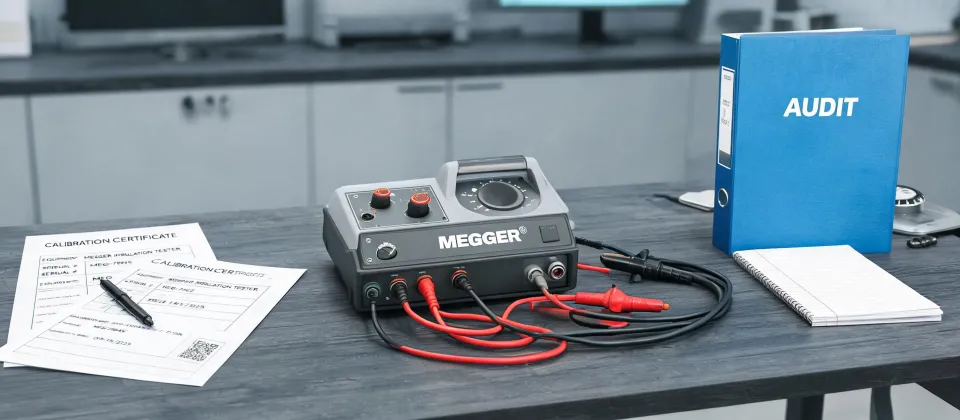
Megger Insulation Testers and Industrial Sensors: A 6-Step Procurement Checklist for Lower TCO
-
Step 1: Define the Test, Not Just the Product
-
Step 2: Count Everything Before Comparing Vendor Quotes
-
Step 3: Match the Sensor to the Environment
-
Step 4: Ask the Calibration Tech What They'll Actually Use
-
Step 5: Cross-Check Compatibility Before You Buy
-
Step 6: Verify Calibration Support Before You Commit
-
What Most People Get Wrong
-
Bottom Line
This checklist is for the person who signs off on test and measurement equipment purchases. Not the first-line tech. Not the maintenance supervisor. The one who sees the invoice when annual instrument spending lands on a cost center. If that's you, I hope this saves you some of the pain I learned the hard way.
Over the past six years, I've managed the instrument budget for a 120-person industrial service company. It's roughly $380,000 a year across Megger insulation testers, temperature sensors, radar level transmitters, calibration services, and spare parts. I've made enough mistakes to appreciate a simple checklist. Here's the one I run through before every major order. It has six steps, and step 4 is the one most people skip.
Use this when you are replacing a Megger insulation tester, comparing a Megger insulation tester 5000v for high-voltage motor work, adding temperature sensors to a process skid, selecting a radar level transmitter, or chasing down replacement sensor compatibility. If that sounds like your afternoon, keep reading.
Step 1: Define the Test, Not Just the Product
It's tempting to think you just need "a Megger insulation tester." The real question is: what test are you running? A 1000V unit is fine for control wiring. A Megger insulation tester 5000v is a different machine, designed for testing motor and transformer windings at higher voltages. If your spec says 5000V, don't let anyone talk you into a 1000V because it's "close enough." Not ideal, not workable.
According to Megger's published specification sheets, actual test voltage accuracy and output current vary by model. A 5 kV unit is not a 1 kV unit with a different faceplate. Check the resistance range, the test current, and whether the instrument can perform a step-voltage or dielectric absorption test. Why does that matter? Because the datasheet's max voltage number is the headline, but the real cost difference is hidden in the measurement features.
Step 2: Count Everything Before Comparing Vendor Quotes
From the outside, vendor quotes look similar. The reality is the line items differ. When I audited our 2023 spending, I found that a ton of our "budget overruns" came from accessories that were not in the base quote. For a Megger insulation tester, check the list below before you start comparing.
- Calibration certificate—does it cost extra?
- Shielded test lead set with the right connectors
- Carrying case or transit case
- PC software or mobile app, if the model supports it
- Shipping, especially if the battery or container triggers hazmat fees
- Rush fees, if you need it before the planned outage window
A few years ago—actually, in Q2 2024—I compared three suppliers for a 5000V insulation tester. The "cheap" quote was 11% lower. With calibration and the correct test leads, the "premium" quote was cheaper. Total cost of ownership. That's the only honest way to compare.
Step 3: Match the Sensor to the Environment
A temperature sensor is not just "a sensor." A radar level transmitter is not just "a level thing." The cheapest option can fail in a week if placed in the wrong environment. In 2022, we ordered six temperature sensors based on price. They were accurate in the lab. On the steam line, one failed within a week because the cable insulation rating wasn't high enough. The replacement cost was four times the savings. That's an expensive lesson.
For a radar level transmitter, check the frequency, antenna type, process connection, and communication output. A unit for a plastic water tank in a dry room is completely different from one measuring liquid in a stilling well with steam, foam, or buildup. People assume the radar level transmitter is a universal black box. It isn't.
Step 4: Ask the Calibration Tech What They'll Actually Use
This is the step most people skip. The spreadsheet said Vendor B was cheaper. My gut said something was off. We bought one anyway, and let the maintenance team use it for a week. Their report software couldn't export PDFs in the format our customer required. The cheaper unit became a very expensive paperweight.
For Megger insulation testers, check data management. If your technicians need to download results on site and email them, make sure that workflow is actually possible. Don't assume that every model has the same app or software. Same for temperature sensors and level transmitters: ask your technicians what configuration tools and communication protocols they already use. If the new instrument doesn't speak MODBUS or HART, it's not compatible with your system. Period.
Step 5: Cross-Check Compatibility Before You Buy
There's a question that shows up the moment a vision system goes down: "does cognex use sony sensors?" People ask it when they're trying to source a replacement image sensor or a spare board. The answer depends on the exact model and revision. Some Cognex camera systems have used Sony sensors; others use different suppliers. Instead of relying on a forum, match the existing part number. That's not dodging the question. That's the correct way to answer it.
The same logic applies to a radar level transmitter replacement. Check the signal protocol, output type, antenna size, and mounting threads before you order. And if you're upgrading to a newer Megger insulation tester, verify that your existing test leads will fit. Lead connectors change between product families. I only believed that after ordering a unit that didn't match our leads and paying $180 for a new set—or rather, $217 with shipping. Not my proudest moment.
Step 6: Verify Calibration Support Before You Commit
An uncalibrated insulation tester is a liability, not an asset. Confirm whether the quoted price includes calibration and whether the lab is ISO/IEC 17025 accredited. Ask about turnaround in writing. In our case, one vendor said "about a week." The actual written quote said five business days. That's the difference between a planned shutdown and an idle crew.
For a Megger insulation tester 5000v, calibration is not optional. If you can't verify calibration, you can't trust the readings. And if you can't trust the readings, the instrument doesn't belong on the job. Simple.
What Most People Get Wrong
Don't buy on max voltage alone. A 5000V unit is not automatically better for every job.
Don't compare list prices without calculating total cost of ownership. The "cheap" quote can hide calibration, accessories, and shipping.
Don't ignore software and data management. A smart instrument that can't export reports is a generation of manual paperwork.
Don't use hearsay for sensor compatibility. Whether it's a Cognex sensor question or a radar level transmitter output, use the part number and official documentation. Not a thread from 2019.
Bottom Line
An informed customer asks better questions and makes faster decisions. The goal is not to find the cheapest quote. It's to find the instrument that works on day one, has calibration support, and doesn't cost double in accessories six months later. Use this checklist on your next Megger insulation tester, temperature sensor, or radar level transmitter order. Your budget—and your maintenance team—will thank you.

Marcus Feld
Marcus Feld is an electrical test and measurement analyst specializing in multimeters, oscilloscopes, clamp meters, insulation testers, spectrum analyzers, and data loggers. He applies IEC 61010-2-030 and IEC 61010-031 concepts while examining measurement category, bandwidth, true-RMS response, input loading, and stated uncertainty. His work helps maintenance engineers and test teams choose safe instruments with performance suited to the signals and environments they actually measure.