Test & Measurement
Megger, Multimeter, or Sensor? How to Choose Without Burning Your Budget
-
Why there is no single best test instrument
-
Scenario A: Insulation testing — where a megger earns its keep
-
Scenario B: Finding the best multimeter for automotive work
-
Scenario C: How sensors compare with Omron and Keyence
-
Scenario D: Set up your Megger login before you need it
-
How to tell which scenario you're in
-
The TCO checklist I use before every test equipment order
I've been handling test and measurement orders for six years, and I've personally made—and documented—eleven significant mistakes. Collectively, those mistakes cost roughly $14,000 in wasted budget. None of them happened because I was careless. They happened because I picked a tool before I asked what job it would actually do. I now maintain our team's checklist, and this article is the first part of it.
When someone asks me 'which Megger should I buy?' I always say the same thing: it depends. There is no universal answer, because there are at least four different jobs hiding inside that question. Here are the scenarios I see most often:
- Scenario A: Insulation testing. You're checking motor windings, cable insulation, or switchgear. You need an insulation tester, often called a megger.
- Scenario B: Automotive and general electrical troubleshooting. You need a multimeter, and if you're working on modern cars, you need a true rms multimeter.
- Scenario C: Industrial sensors. You're integrating or replacing sensors, and you keep wondering how sensors compare with Omron and Keyence.
- Scenario D: Data and compliance. You already own the instrument, but now you need to manage test records, firmware, and calibration certificates. That's where the Megger login and software matter.
If you're currently standing in the test-equipment aisle, here's how to avoid the mistakes I made.
Why there is no single best test instrument
An insulation tester and a multimeter both measure resistance, but they're not interchangeable. A sensor from Omron isn't competing with a megger. And the best multimeter for automotive work isn't necessarily the one with the most features. The first question isn't 'which brand?' It's 'which category, and what's the total cost over two years?'
I now calculate total ownership cost (TCO) before comparing any vendor quotes. That means purchase price plus calibration, accessories, training, downtime, software, and the cost of a wrong reading. The cheapest quote usually isn't the cheapest by the time a bad result stops your line.
The $500 quote turned into $800 after shipping, setup, and revision fees. The $650 all-inclusive quote was actually cheaper.
Scenario A: Insulation testing — where a megger earns its keep
I used to think the 20 MΩ resistance range on my multimeter was enough for insulation checks. It wasn't. A megger applies a controlled high voltage, usually 500V, 1000V, or 2500V, and measures insulation resistance while the equipment is de-energized. A regular meter doesn't do that safely or accurately.
You can buy a megger from several manufacturers. The company that gave the category its name is Megger, and their instruments are solid. But don't buy the biggest model out of habit. Choose the test voltage that matches your equipment. If you only work on low-voltage control circuits, a 500V tester is probably enough. If you're testing distribution cables, you may need a 5kV model.
This is also where TCO gets interesting. I compared a $460 megger and a $720 megger. The cheaper one worked fine, but it took longer to discharge the cable after each test. Over 100 tests, that added up to about two hours of unnecessary waiting. At our shop rate, the $720 model was actually the cheaper one. That's the kind of math that doesn't show up on a spec sheet.
Bottom line: if you do insulation testing, buy a real megger. The multimeter stays in the bag.
Scenario B: Finding the best multimeter for automotive work
Now let's talk about the 'best multimeter for automotive' question, because it's a different scenario. If you're chasing a parasitic drain, checking sensor signals, or diagnosing a no-start, you need a meter with good resolution, a clear display, and quick response. You don't need an insulation tester.
And if you're working on modern cars, you need true RMS. Standard averaging meters can give you weird readings on pulse-width-modulated signals, like those found on modern fuel injectors and variable-speed cooling fans. A true rms multimeter gives you a reliable number instead of a confusing one.
I went back and forth between the Fluke 289 true rms multimeter and a less expensive model for two weeks. On paper, the cheaper meter had similar ranges. But the 289 had two things I didn't know I needed: a low-pass filter for variable-frequency drives, and built-in logging. The low-pass filter is a game-changer when you're testing around VFDs and hybrid inverters. The logging saved me when I needed to prove a voltage drop wasn't intermittent.
The numbers said save the money. My gut said I'd regret it. I bought the 289 anyway, and I've never regretted it. But that doesn't mean it's the right meter for everyone. If you mainly work on 12V wiring and standard passenger cars, a good $200 true-RMS meter can be enough. The 289 is not a no-brainer for every toolbox.
Safety note: check the meter's category rating before you use it on anything with high energy. According to IEC 61010-1, a CAT III 600V rating is designed for distribution-circuit work. Hybrid and electric vehicles can have DC bus voltages in the 300V to 600V range, so a cheap CAT II meter is a red flag. With automotive, the total cost of a wrong meter includes your safety.
Scenario C: How sensors compare with Omron and Keyence
The third scenario is less about electrical safety and more about industrial control. You're on a production line, replacing a failed photoelectric sensor or adding more sensors to a new station. You search online, and the common question is 'how sensors compare with Omron and Keyence.'
I have mixed feelings about brand comparisons in sensors. On one hand, both Omron and Keyence make excellent products. On the other hand, anyone who tells you one is universally better hasn't priced the full system. The real difference is in integration, support, and lead time.
Omron has a broad ecosystem. If your PLC is Omron, their sensors will communicate with almost no friction, and spare parts are easy to source. Keyence is known for aggressive innovation and incredible application support. Their engineers often come to your site, test the sensor, and help you install it. That support costs money, but it can be worth every dollar if your team doesn't have in-house automation expertise.
I once had to quote a bank of sensors for a filling line. Omron quote: $1,800. Keyence quote: $2,700. I almost chose Omron based on price alone. But Keyence included a site visit, custom mounting brackets, and same-day technical support. The line was down, and every hour of downtime was worth more than the $900 difference. I don't have hard data on which sensor family fails less over time. What I can say anecdotally is that both worked without issues for the first year. The difference was in how fast we got help when something confused us.
This approach worked for us, but our situation might be different from yours. If you have a strong in-house automation team, Keyence's support is less valuable and Omron's lower price becomes the deciding factor. If you don't, the premium might be the cheapest insurance you ever buy.
Scenario D: Set up your Megger login before you need it
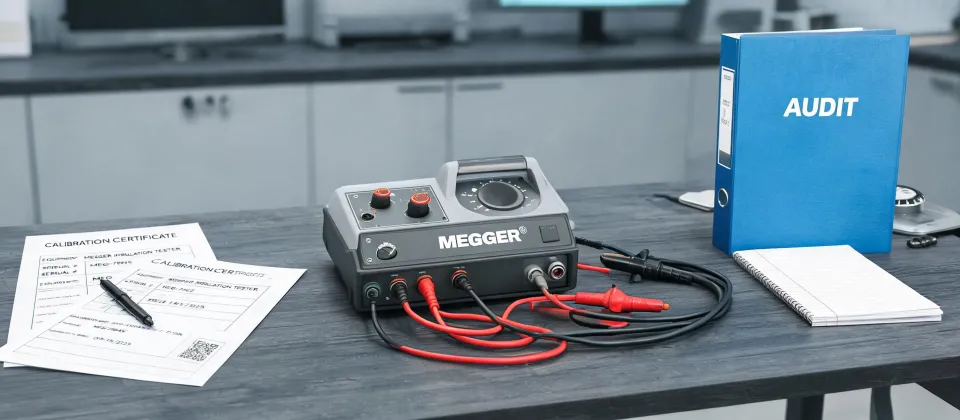
This is the least exciting scenario, but it's the one that cost me the most embarrassment. I bought a megger, used it for two weeks, and never registered it. Then an auditor asked for calibration records and stored test data. I couldn't download the results because I didn't have my Megger login and I didn't know which software version was installed.
Set up your Megger login as soon as the instrument arrives. Register the serial number, download the latest firmware, and save calibration documentation. It takes about 20 minutes. Skipping it turned a routine audit request into a two-day scramble for me, and it cost more in trust than in dollars.
If your quality team needs traceability, data export is a feature, not a luxury. That's part of TCO too. I wish I had tracked the hours we spent chasing paperwork. I can tell you anecdotally that it was way more than we spent on calibration.
How to tell which scenario you're in
If you're not sure which category fits, here's the quick self-check I use with our new hires:
- Are you testing insulation on cables, motor windings, or switchgear? Start at Scenario A and buy a megger.
- Are you troubleshooting electrical faults on a vehicle or a VFD? Start at Scenario B and look for a true rms multimeter.
- Are you choosing sensors for a production line? Start at Scenario C and compare Omron and Keyence on support and integration, not just price.
- Do you already own a meter and need to retrieve data or certifications? Start at Scenario D and set up your Megger login and software.
If you're in two scenarios at once, don't look for a single tool that does everything. I've tried that. A megger isn't a multimeter, and a multimeter isn't a megger. Buy the tool that covers the highest-risk work first, then add the second tool when the budget allows.
The TCO checklist I use before every test equipment order
- Purchase price, plus shipping and any setup fees.
- Calibration cost and calibration interval.
- Power source, rechargeable batteries, and accessories.
- Training time for the people who will actually use it.
- Software and data export capabilities.
- Estimated downtime cost if the tool fails or gives a bad reading.
There is no universal 'best megger' or 'best multimeter for automotive' or 'best sensor brand' that applies to everyone. There's only the right answer for your specific scenario. Count the total cost, not the sticker price, and you'll avoid the $14,000 education I paid for.

Marcus Feld
Marcus Feld is an electrical test and measurement analyst specializing in multimeters, oscilloscopes, clamp meters, insulation testers, spectrum analyzers, and data loggers. He applies IEC 61010-2-030 and IEC 61010-031 concepts while examining measurement category, bandwidth, true-RMS response, input loading, and stated uncertainty. His work helps maintenance engineers and test teams choose safe instruments with performance suited to the signals and environments they actually measure.